

You've cracked the code on your first few Amazon products. Sales are rolling in, your margins look decent, and you're ready to scale. But here's the thing, scaling on Amazon in 2026 isn't just about launching more products or throwing more money at ads. It's about avoiding the seven critical mistakes that quietly drain your profits and stall your growth.
Most sellers hit a ceiling around the $500K-$1M mark, not because they lack ambition, but because they're making predictable, fixable errors that professional Amazon agencies see (and solve) every single day.
In this post, we'll break down the exact mistakes that are holding you back and, more importantly, how to fix them. Whether you're DIY-ing your Amazon business or considering bringing in expert help, these insights will save you thousands in wasted ad spend and missed opportunities.
Let's dive in!
Mistake #1: Improvising Without Data-Driven Systems
The Problem:
You launched your first product based on gut feeling. Maybe you noticed a trend on social media or had a brilliant idea in the shower. And guess what? It worked! But now you're trying to replicate that success, and suddenly nothing's hitting the same way.
Here's what's happening: You're guessing instead of using data-driven research and repeatable processes. The Amazon landscape in 2026 is exponentially more competitive than it was even two years ago. What worked through intuition in 2023 now requires systematic analysis.
The sellers who scale successfully aren't the ones with the best hunches, they're the ones with the best data infrastructure.
How to Fix It:
Replace intuition with consistent, data-backed decision-making:
- Use product research tools like Helium 10, Jungle Scout, or Cerebro to analyze search volume, competition levels, and historical trends
- Build decision frameworks that score potential products on multiple criteria (margin potential, competition, seasonality, etc.)
- Track your metrics religiously: conversion rates, ACOS, TACOS, traffic sources, and customer acquisition costs
- Leverage Amazon's New Selection Success Guide to reduce launch risk with data-backed recommendations
When you have repeatable systems, scaling becomes about execution rather than luck. An experienced amazon account management service brings these systems built-in, along with historical performance data across hundreds of launches.

Mistake #2: Chasing New Products Instead of Optimizing What You Have
The Problem:
New product launches are exciting. They're shiny, full of potential, and feel like progress. But here's the brutal truth: The fastest growth typically comes from improving what you already sell.
Most sellers focus 80% of their energy on launching new products and only 20% on optimizing existing listings. It should be the opposite.
Your current catalog is sitting on untapped revenue. A 2% increase in conversion rate on a product doing $50K/month is an extra $1,000 monthly, with zero launch risk, no inventory investment, and no additional ad spend required.
How to Fix It:
Make listing optimization a quarterly discipline:
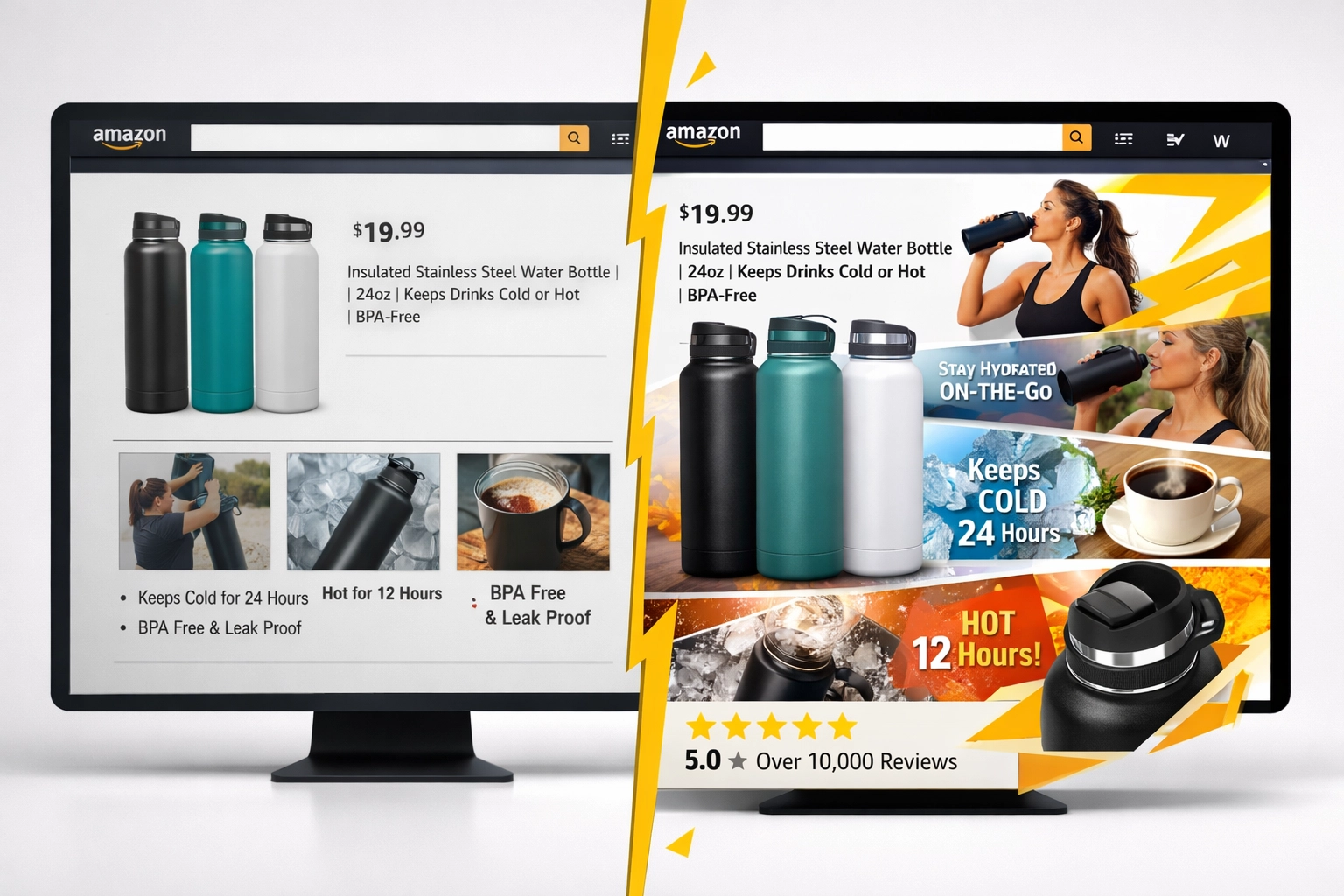
- Refresh product images with lifestyle shots, comparison charts, and benefit-focused graphics
- Rewrite titles and bullet points using current keyword research (search terms evolve constantly)
- Test enhanced A+ Content variations using Amazon's split-testing tools
- Update backend search terms based on actual customer queries and emerging trends
- Analyze "customer questions" for content gaps your listing isn't addressing
Pro tip: Focus optimization efforts on your top 20% of SKUs first. These products already have traction, reviews, and ranking history. Small improvements here compound faster than moderate success on brand-new launches.
This is where amazon listing optimization expertise really shines, agencies bring fresh eyes and conversion-focused copywriting that DIY sellers often miss.
Mistake #3: Ignoring the Compounding Squeeze of Rising Costs
The Problem:
Amazon's fee changes in 2026 aren't just annoying, they're creating a cascade failure in unit economics. Rising FBA fees, escalating ad costs, and increased operational challenges are hitting simultaneously.
Here's why this is more serious than it sounds: A 2% fee increase isn't just a 2% profit loss. It's a systemic compression that makes previously profitable ad campaigns suddenly unprofitable.
Let's break down the math:
- Before: Product sells for $30, COGS $8, FBA fees $6, profit $16 (53% margin)
- After fees increase: Same product, COGS $8, FBA fees $6.60, profit $15.40 (51% margin)
- Impact on ads: You previously could spend $8/unit on ads (50% ACOS) and still profit $8/unit
- Now: That same $8 ad spend drops your profit to $7.40/unit, a 7.5% reduction in actual take-home
Multiply this across your entire catalog and thousands of units, and you're looking at five or six figures of annual profit evaporation.
How to Fix It:
Build margin resilience into your business model:
- Audit your true unit economics monthly, include ALL costs (returns, storage, removals, customer service)
- Implement dynamic pricing strategies that adjust for seasonality and competition
- Negotiate better COGS by consolidating suppliers or increasing order volumes
- Explore bundling strategies that increase AOV without proportionally increasing ad spend
- Consider hybrid fulfillment (more on this in Mistake #5)
Expert amazon ads management teams recalibrate campaign strategies constantly to maintain profitability as the ecosystem shifts. They're watching these compression points daily and adjusting before you even see the impact.
Mistake #4: Neglecting Early Trust-Building Through Reviews
The Problem:
You launch a new product, run some PPC, get a few sales… and then momentum dies. Why? Not enough social proof.
In 2026, Amazon buyers are more skeptical than ever. They've been burned by dropshipped junk, misleading photos, and fake reviews. Your product might be amazing, but without reviews, you're asking customers to take a $30-$60 leap of faith.
Reviews aren't just ratings, they're insight engines that tell you:
- What customers expected vs. what they received
- Which features matter most
- Where your listing is unclear or misleading
- What your competitors are doing better
How to Fix It:
Build a systematic review acquisition process:
- Use Amazon Vine Program for new launches (up to 30 reviewers per parent ASIN)
- Enroll in Amazon's Early Reviewer Program if still available in your category
- Send follow-up emails via Amazon Buyer-Seller Messaging (within ToS guidelines)
- Insert product inserts with QR codes linking to support (NOT directly soliciting reviews)
- Monitor and respond to reviews to show active customer engagement
Critical point: Never, ever buy fake reviews or offer incentives for positive reviews. Amazon's detection in 2026 is frighteningly sophisticated, and the penalties (suspension, permanent ban) aren't worth the shortcut.
Professional amazon brand management teams implement review acceleration strategies that stay 100% compliant while dramatically shortening the time-to-trust for new products.
Mistake #5: Over-Relying on FBA Without Diversification
The Problem:
FBA is incredible: until it's not. In December 2025, some FBA listings were temporarily hidden regionally due to system issues. Sellers dependent solely on FBA watched their sales crater overnight.
Meanwhile, sellers with Fulfilled by Merchant (FBM), Shopify stores, or wholesale channels barely noticed the disruption. They simply redirected traffic and kept operating.
The reality: Amazon's systems are complex and occasionally break. Putting 100% of your fulfillment eggs in the FBA basket is a single-point-of-failure risk that most growing sellers ignore… until it's too late.
How to Fix It:
Build fulfillment redundancy:
- Implement hybrid fulfillment: Keep fast-moving SKUs in FBA, slower items in FBM or 3PL
- Stage inventory outside Amazon at a 3PL partner, feeding FBA gradually
- Explore Seller Fulfilled Prime if you have the infrastructure and consistency
- Launch a Shopify store as a backup channel (Amazon's external link restrictions are loosening)
- Consider wholesale or B2B channels to diversify beyond direct-to-consumer
The goal isn't to abandon FBA: it's to not be completely dependent on it. A 70/30 split (FBA/alternative) gives you resilience without sacrificing Prime badge benefits on your main catalog.

Mistake #6: Not Adapting to Tighter Inventory Limits
The Problem:
Amazon reduced storage allowances from six months to five months of forecasted sales in mid-2025. If you're still managing inventory like it's 2023, you're either:
- Stocking out during peak season (leaving money on the table)
- Paying excess storage fees (destroying margins)
- Getting restock limit surprises (scrambling with air freight)
Inventory planning in 2026 requires military precision. The days of "ship everything to FBA and forget about it" are over.
How to Fix It:
Master inventory velocity and forecasting:
- Use Amazon's Restock Inventory Report weekly (not monthly)
- Calculate your IPI score components and optimize specifically for what's dragging you down
- Implement just-in-time restocking with safety stock buffers built in
- Use reserve storage strategically during Q4 to smooth out capacity constraints
- Track days of inventory as your primary metric, not just units available
Formula to live by:
Days of Inventory = (Units in Stock ÷ Average Daily Units Sold) × 1
Aim for 30-45 days in FBA, 60-90 days staged at your 3PL or freight forwarder.
Professional agencies often include inventory planning and FBA prep services as part of account management, because they know margins live and die on getting this balance right.
Mistake #7: Misunderstanding Unit Economics and Profitability Thresholds
The Problem:
This is the silent killer. You're selling products, seeing revenue grow, feeling like a success story… and somehow never building meaningful wealth.
Why? Your unit economics are broken, and you don't realize it.
Many Amazon sellers operate on 8-12% net profit margins. That's not a business: that's a job with extra steps. A good net profit margin for Amazon FBA in 2026 should be 15-20% minimum. Anything less leaves you vulnerable to the smallest disruption.
Too many sellers:
- Underestimate competition when selecting products
- Choose products with inherently low profit margins
- Don't plan for sufficient working capital before reaching profitability
- Confuse revenue growth with actual profit growth
How to Fix It:
Get crystal clear on your true profitability:
- Calculate your all-in unit economics: COGS + shipping + FBA fees + ads + returns + storage + refunds
- Track contribution margin, not just gross margin
- Build a target ACOS formula: Max ACOS = (Selling Price – COGS – Fulfillment – Desired Profit) ÷ Selling Price
- Review P&L monthly with Amazon-specific accounting (not just QuickBooks guesswork)
- Run regular reimbursement audits to recover lost FBA inventory value
Example target:
- Selling price: $40
- COGS: $10
- FBA + shipping: $8
- Desired profit: $8 (20%)
- Max ACOS: 35% ($14 ad spend per unit)
If your ACOS is consistently above this threshold, you need to either improve conversion rate, reduce ad spend, or sunset the product.

The Bottom Line: Why Agencies Solve These Faster
Here's what we've covered:
✅ Build data-driven systems instead of guessing your way to scale
✅ Optimize existing products before chasing new launches
✅ Understand fee compression and build margin resilience
✅ Accelerate reviews with compliant, systematic approaches
✅ Diversify fulfillment to eliminate single points of failure
✅ Master inventory velocity to stay within Amazon's constraints
✅ Fix unit economics to build real wealth, not just revenue
Could you learn all of this yourself? Absolutely. Will it take 12-18 months of expensive mistakes? Also yes.
This is exactly why businesses at the $500K-$5M range bring in professional Amazon agencies. Not because they can't do it themselves, but because agencies have already made these mistakes (on someone else's dime), built the systems to prevent them, and can implement fixes in weeks instead of quarters.
The ROI calculation is simple: If hiring an agency prevents even one of these mistakes: say, avoiding a $20K inventory stockout or reducing wasted ad spend by $3K/month: it pays for itself in 60 days.
Ready to Scale Without the Mistakes?
Scaling on Amazon in 2026 doesn't have to be a trial-by-fire experience. Whether you implement these fixes yourself or bring in experts to handle them, the key is recognizing these patterns early.
At Marketplace Valet, we specialize in helping brands scale profitably on Amazon without the costly learning curve. From advertising management to listing optimization to strategic account management, we've built systems that work.
Got questions about scaling your Amazon business? Drop a comment below or reach out to our team. We'd love to hear where you're getting stuck: and help you break through to the next level.