

You've hit $50K, $100K, maybe even $500K per month on Amazon. Your brand is growing. Sales are climbing. But here's what's also growing: the complexity, the time commitment, the pressure to optimize every detail while Amazon rolls out new features faster than you can implement them.
If you're wondering whether it's time to bring in an amazon agency to help scale your brand: or if you can keep doing it all in-house: you're asking the right question at exactly the right time.
In this post, we'll break down:
- 7 specific reasons why scaling brands partner with Amazon agencies in 2026
- What to look for when evaluating amazon account management services
- Red flags to avoid when choosing an agency partner
- How to structure the relationship for maximum ROI
Let's dive in.
Why Scaling Brands Are Turning to Amazon Agencies in 2026
The Amazon marketplace in 2026 isn't what it was three years ago. Between AI shopping assistants like Rufus, full-funnel advertising strategies, prep service changes, and tightening compliance standards, running a seven-figure Amazon brand requires specialized expertise across multiple disciplines.
Here's why brands at your stage are increasingly partnering with agencies.

1. Amazon Advertising Has Become a Full-Time Specialty
Remember when Sponsored Products campaigns were enough? Those days are gone.
In 2026, competitive amazon ads management requires:
- DSP campaigns for mid- and upper-funnel awareness
- Sponsored Brand Video placements
- Prime Video shoppable ads integration
- Full-funnel attribution modeling
- AI-powered bidding optimization across multiple campaign types
An experienced amazon advertising agency manages this ecosystem daily: testing, optimizing, and scaling campaigns while you focus on product development and inventory planning.
What this means for you: Your in-house team can't simultaneously master product launches, inventory management, customer service, and the constantly evolving ad platform. Agencies bring specialized PPC expertise that directly impacts your profitability.
2. Listing Optimization Now Includes AI Shopping Assistant Readiness
Your product listings aren't just competing for customer attention anymore: they're competing for Rufus's attention.
Amazon listing optimization in 2026 requires:
- Structured data that AI assistants can parse and summarize
- Natural language optimization for voice shopping queries
- Video and A+ content that enhances discoverability
- Mobile-first design and quick-load images
- Backend keyword strategies that work with semantic search
Agencies with amazon brand management expertise understand how to optimize listings for both human shoppers and AI systems: a skill set most in-house teams are still developing.
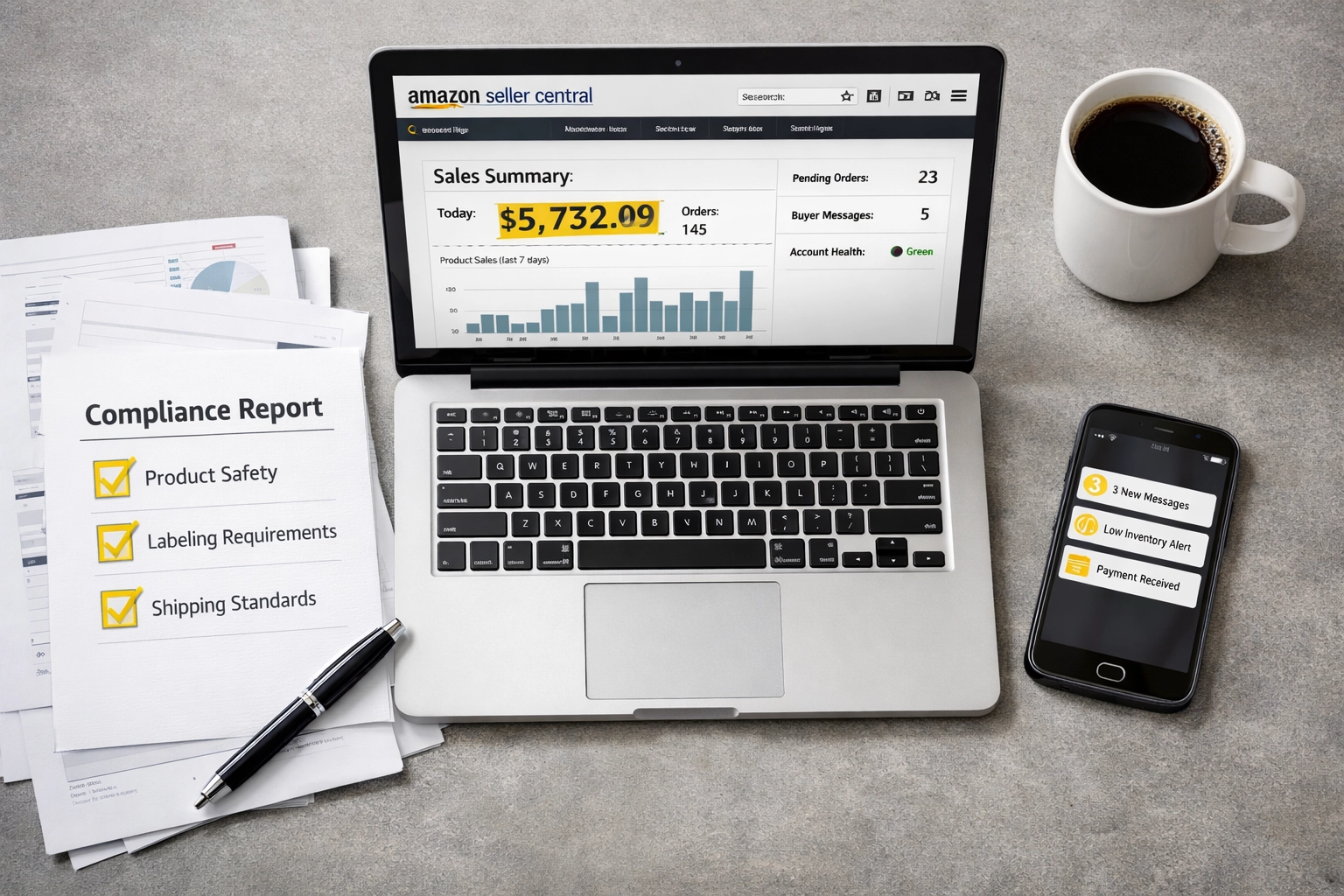
3. Policy Compliance and Account Health Require Constant Vigilance
Amazon's compliance standards tighten every quarter. One mistake: an incorrect UPC, a prep violation, a listing claim issue: can trigger suspensions that cost you thousands per day in lost revenue.
Professional amazon account management services include:
- Proactive monitoring of account health metrics
- Expert amazon seller support escalation when issues arise
- Documentation systems that prove compliance
- Rapid response protocols for listing suspensions
Here's the thing: When your account gets hit with a policy violation at 3 PM on Friday, having an agency with established Amazon rep relationships can mean the difference between a weekend resolution and a two-week revenue freeze.
4. FBA Prep and Logistics Have Become More Complex
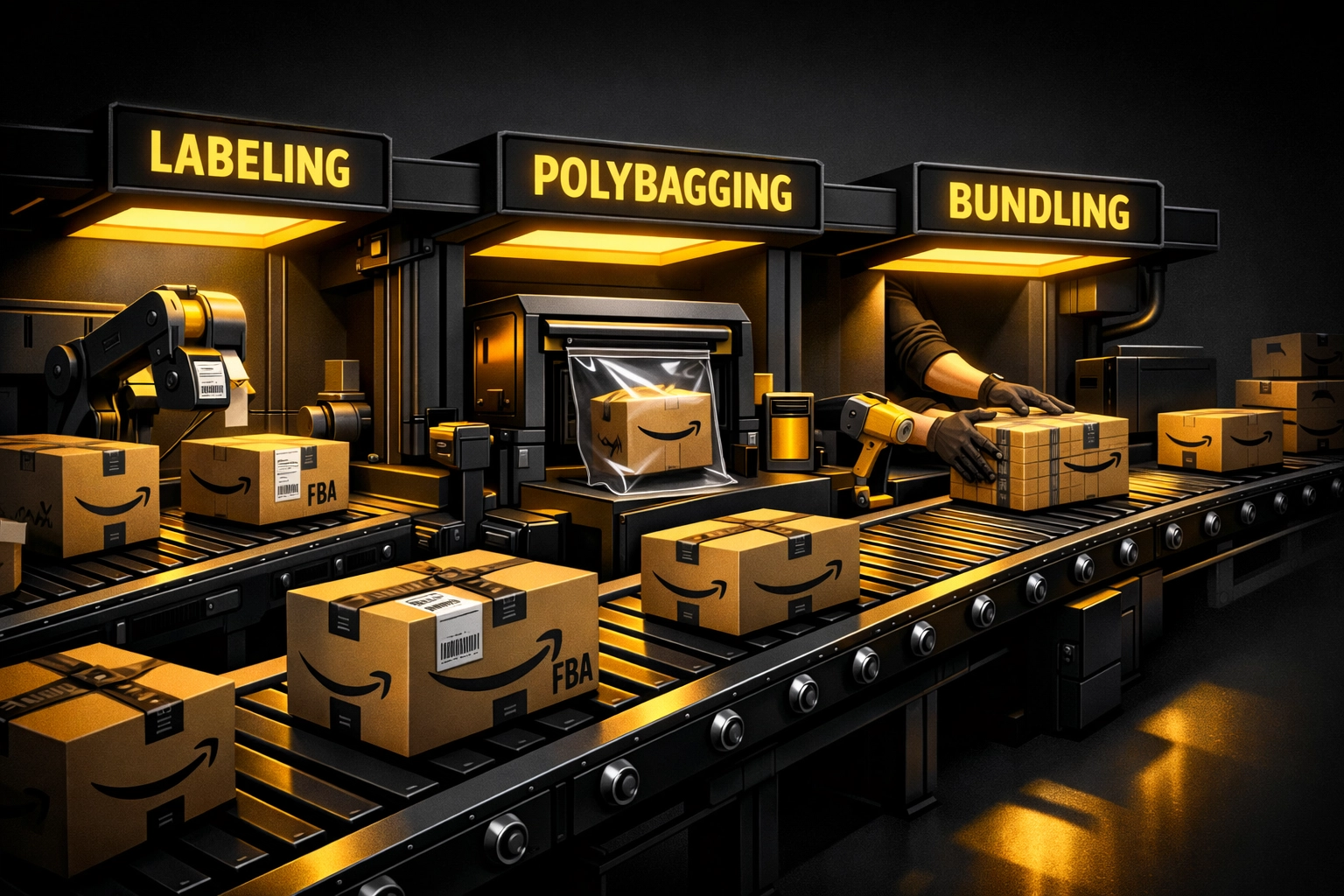
With Amazon ending their FBA prep services and commingling rules changing, brands need reliable amazon fba prep service partners who understand Amazon's exact requirements.
Full-service agencies either provide prep services in-house or maintain vetted partnerships with prep centers that:
- Stay current on Amazon's labeling requirements
- Handle polybagging, bundling, and hazmat compliance
- Coordinate directly with your warehouse and Amazon FCs
- Manage shipment creation and tracking
5. Reimbursement Audits Recover Money You're Leaving on the Table
Most brands lose 1-3% of revenue to Amazon errors: lost inventory, damaged returns, incorrect fees, customer refunds without returned inventory.
Agencies that include amazon reimbursement audit services systematically:
- Scan your account for reimbursement opportunities
- File claims on your behalf
- Track resolutions through Amazon's case system
- Recover funds that would otherwise remain unclaimed
Real numbers: On a $2M annual revenue account, that's $20,000-$60,000 in recoverable funds sitting in Amazon's system.

6. Data-Driven Strategy Requires Tools and Experience
Scaling in 2026 means making decisions based on data, not gut feeling.
Professional agencies use enterprise tools for:
- Profit margin analysis across your entire catalog
- Competitor pricing and promotion monitoring
- Inventory forecasting that prevents stockouts
- Brand analytics interpretation
- Attribution modeling across traffic sources
These tools cost thousands per month: and require expertise to extract actionable insights. When you partner with an amazon agency, you get access to both the tools and the analysts who know how to use them.
7. Strategic Bandwidth Frees You to Focus on Growth
Here's the most important reason: Your time is finite.
Every hour you spend troubleshooting a Seller Support case, optimizing PPC bids, or filing reimbursement claims is an hour you're not spending on:
- Developing new products
- Building relationships with suppliers
- Expanding to new channels
- Strategic planning
The right agency partnership doesn't just execute tasks: it creates strategic bandwidth that lets you focus on the high-leverage activities that actually grow your business.
How to Choose the Right Amazon Agency (Without Getting Burned)
Not all amazon advertising agencies are created equal. Here's your evaluation framework.
What to Look For
✅ Specialized Amazon Expertise
Look for agencies that work exclusively with Amazon sellers, not general e-commerce agencies that "also do Amazon."
✅ Transparent Reporting
Your agency should provide weekly performance reports with clear metrics: ACOS, TACOS, conversion rates, inventory health, and profitability analysis.
✅ Proven Results in Your Category
Ask for case studies from brands in similar categories at similar revenue stages.
✅ Direct Communication
You should have a dedicated account manager, not get routed through a ticket system.
✅ Services That Match Your Needs
Some agencies specialize in advertising, others in full account management. Match their strengths to your gaps. For example, if you're strong on product development but weak on advertising, prioritize agencies with deep PPC expertise.
Red Flags to Avoid
❌ Guaranteed Rankings or Sales
No legitimate agency can guarantee specific sales outcomes or keyword rankings. Amazon's algorithm has too many variables.
❌ Long-Term Contracts Without Performance Clauses
Quality agencies are confident in their results. If they require 12-month commitments with no performance benchmarks, walk away.
❌ Vague Pricing Structures
You should understand exactly what you're paying for: percentage of ad spend, monthly retainer, performance fees, or hybrid models.
❌ No Direct Amazon Experience
Ask how long team members have worked specifically with Amazon. "E-commerce experience" isn't the same as Amazon expertise.
❌ Cookie-Cutter Strategies
Every brand has different margin structures, competition levels, and growth goals. Agencies should customize strategies, not apply templates.
Questions to Ask During Discovery Calls
- "What tools do you use for advertising optimization and reporting?"
- "How do you handle Seller Support escalations when account issues arise?"
- "Can you walk me through how you'd audit my current advertising account?"
- "What's your typical timeline for seeing improvements in ACOS?"
- "Do you provide amazon reimbursement audit services, or would we need a separate partner?"
- "How do you stay current on Amazon's policy changes and new features?"
The ROI Calculation: When Does an Agency Make Financial Sense?
Here's the simple math:
If your brand is doing $500K+ annually on Amazon, an agency typically costs between $3K-$10K per month (depending on services and revenue).
If they improve your:
- ACOS by 5 percentage points
- Profit margin by 2% through reimbursements and fee optimization
- Conversion rate by 1% through listing optimization
You'll likely see 3-5x ROI on the agency investment: plus gain back 20-30 hours per week of strategic bandwidth.
Below $500K annual revenue, you might be better served by an in-house approach or hiring specific freelancers for high-impact tasks.
Making the Partnership Work
Once you've chosen an agency, set it up for success:
Week 1-2: Onboarding
- Grant appropriate access levels (advertising, inventory, Seller Central)
- Share historical performance data and current challenges
- Align on KPIs and reporting cadence
Month 1: Audit and Strategy
- Review current account health, advertising structure, and listing optimization
- Identify quick wins and long-term opportunities
- Establish baseline metrics
Month 2-3: Implementation and Testing
- Launch new campaign structures
- Optimize listings and A+ content
- Implement tracking and reporting systems
Month 4+: Optimization and Scaling
- Refine strategies based on performance data
- Scale what's working, cut what's not
- Strategic quarterly planning sessions
Communication rhythm: Weekly performance check-ins, monthly strategy reviews, quarterly business planning.
Final Thoughts: The Scaling Inflection Point
There comes a moment in every Amazon brand's growth journey when doing everything yourself stops being efficient and starts being expensive.
That moment usually hits somewhere between $500K and $2M in annual revenue: when the complexity overwhelms individual bandwidth, when margin optimization becomes critical, and when competitors with agency support start outmaneuvering your in-house efforts.
If you're at that inflection point, the question isn't whether you can keep doing it yourself: it's whether you should.
The right amazon agency partnership doesn't just execute tasks. It multiplies your strategic capacity, brings specialized expertise you can't economically build in-house, and creates the bandwidth for you to focus on the growth activities that actually move the needle.
Your next step: If you're considering agency support, start having discovery conversations now: even if you're not ready to sign a contract. Understanding your options positions you to move quickly when the time is right.
Questions about what agency services make sense for your brand stage? Let's talk about your specific situation.