

You've done it. Your Amazon business is profitable. Orders are flowing in, reviews are stacking up, and you're ready to scale.
But here's the thing, scaling on Amazon in 2026 isn't what it used to be. The platform has evolved dramatically. AI-powered ad systems, stricter FBA prep requirements, tighter inventory limits, and fee increases are changing the game entirely. What worked last year might be quietly draining your margins today.
The sellers who successfully scale aren't just working harder, they're avoiding critical mistakes that trip up the majority. And many are discovering that partnering with an amazon agency isn't a luxury; it's a strategic advantage that protects profit while accelerating growth.
In this post, we'll break down the 7 most common (and costly) scaling mistakes Amazon sellers are making right now, and how the right amazon account management services can help you avoid them entirely.
Let's dive in!
Mistake #1: Prioritizing Speed Over Preparation
The Problem:
You've got momentum, so you rush new products to market. It feels productive. It feels like growth.
Until it's not.
Launching without solid research is one of the fastest ways to burn cash on Amazon in 2026. The competition is fiercer, ad costs are higher, and Amazon's algorithm rewards prepared sellers who understand their market deeply before they launch.
Here's what happens when you skip preparation:
- You launch products with weak demand or oversaturated competition
- Your ad spend balloons trying to force visibility on a product nobody wants
- Inventory sits unsold, eating storage fees and tying up capital
- You're constantly reacting instead of executing a strategy
Why This Happens:
Most sellers confuse activity with progress. Launching feels like scaling. But without batch scanning tools, bulk product research, and proper competitive analysis, you're essentially gambling.
How an Amazon Agency Helps:
A professional amazon brand management team uses advanced research tools to identify profitable opportunities before you invest a dime. They assess:
- True demand vs. perceived demand
- Competitive landscape and pricing pressure
- Keyword difficulty and ad cost projections
- Seasonality and trend analysis
They don't just validate your ideas, they bring you opportunities you never would've found on your own.

Mistake #2: Scaling Without a Stable Foundation
The Problem:
You see other sellers crushing it at $100K/month and think, "I need to scale NOW."
But here's what you don't see: those sellers have systems in place that you don't.
Scaling before your foundation is stable is like building a second story on a house with a cracked foundation. Eventually, everything collapses.
Ask yourself:
- Is your spend pacing predictable, or does it fluctuate wildly?
- Are your campaigns structured logically, or are they a chaotic mess?
- Do you regularly run out of inventory, or do you have alignment between sales velocity and stock levels?
- Can you explain your TACoS (Total Advertising Cost of Sales) for each product line?
If you answered "no" or "I'm not sure" to any of these, you're not ready to scale.
Why This Happens:
Sellers mistake revenue growth for business health. But if your campaigns are disorganized, your inventory planning is reactive, and you don't understand your true unit economics, scaling just amplifies the chaos.
How an Amazon Agency Helps:
An experienced amazon advertising agency stabilizes your foundation first. They:
- Rebuild campaign structures for clarity and control
- Implement proper budget pacing to prevent overspend
- Align inventory planning with sales forecasts
- Create dashboards that show real profitability (not just vanity metrics)
Only after these systems are humming do they flip the switch on aggressive scaling. That's the difference between sustainable growth and a costly crash.
Mistake #3: Making Decisions Based on Intuition Instead of Data
The Problem:
"I think we should lower the price."
"This product feels like it's not working."
"Let's increase the ad budget: we need more sales."
Sound familiar? Gut feeling can get you started, but intuition-based decisions destroy margins at scale.
Amazon in 2026 is a data game. Sellers who wing it get crushed by sellers who use tools like:
- Revenue Calculator to understand true profitability
- Product Opportunity Explorer to identify gaps in the market
- Voice of Customer Dashboard to see exactly what customers want
- Brand Analytics to track competitive share of voice
Why This Happens:
Most sellers don't know these tools exist, or they don't have time to use them properly. So they make changes based on hunches, then wonder why performance gets worse instead of better.
How an Amazon Agency Helps:
Professional amazon ads management teams live in the data. They don't guess: they analyze. They use Amazon's native tools plus third-party analytics platforms to:
- Identify which SKUs are actually profitable (not just high-revenue)
- Spot trends before they become problems
- Make bid adjustments based on conversion patterns, not feelings
- Test pricing strategies with controlled experiments
When you work with an agency, every decision is backed by evidence. That's how you protect margin while scaling.

Mistake #4: Ignoring Profit Metrics That Matter
The Problem:
You're obsessed with ACoS (Advertising Cost of Sales). You celebrate when it drops below 20%. You panic when it spikes above 30%.
But here's the uncomfortable truth: ACoS alone is a terrible metric for scaling decisions.
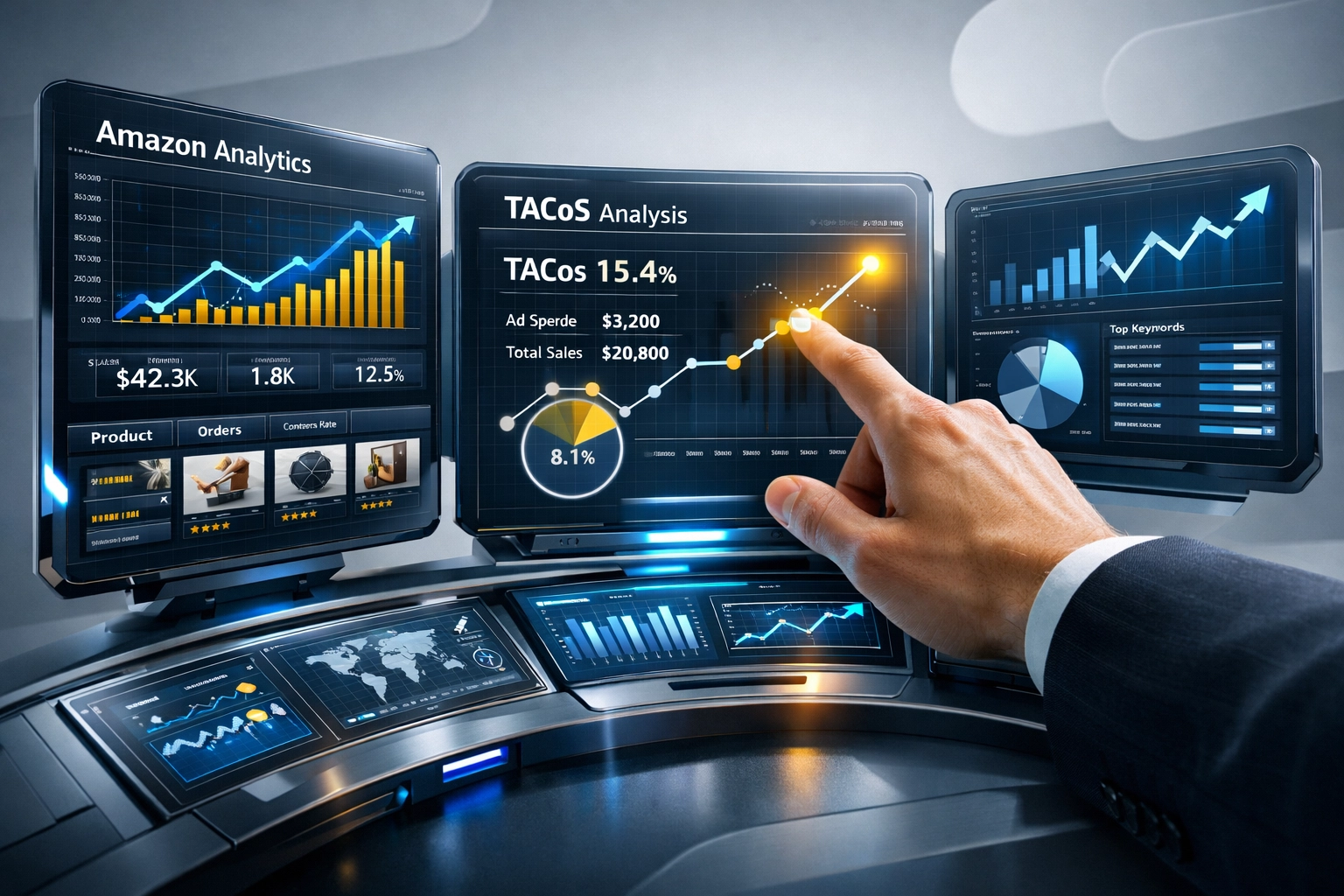
What matters more? TACoS (Total Advertising Cost of Sales): the ratio of ad spend to total revenue, including organic sales.
Here's why:
- A product with 35% ACoS but strong organic sales growth might be a scaling opportunity
- A product with 18% ACoS but declining organic rank might be dying
- Focusing only on ACoS causes you to cut budgets on products that are actually building brand momentum
Why This Happens:
Amazon Seller Central makes ACoS easy to see. TACoS requires custom reporting. Most sellers take the path of least resistance and optimize for the wrong metric.
How an Amazon Agency Helps:
Agencies that specialize in amazon account management services build comprehensive reporting that shows:
- TACoS trends over time
- Contribution margin by SKU (revenue minus all costs, not just ad spend)
- New-to-brand customer acquisition rates
- Lifetime value projections for different product lines
They help you understand which products deserve aggressive ad spend (even if ACoS is higher) and which ones are margin killers in disguise.
Mistake #5: Neglecting Listing Optimization as You Scale
The Problem:
When you had 5 products, you obsessed over every word in your bullet points. You A/B tested images. You refined your A+ Content until it was perfect.
Now you have 50 products, and listing quality has quietly deteriorated.
Titles are inconsistent. Images don't follow brand guidelines. Bullet points are written hastily. A+ Content is copy-pasted from competitors.
And here's the painful part: every 1% drop in conversion rate costs you thousands in wasted ad spend.
If your listing converts at 10% instead of 12%, you're paying 20% more per sale. Scale that across dozens of products and six-figure ad budgets, and you're leaving massive profit on the table.
Why This Happens:
Listing optimization doesn't feel urgent. It's not a crisis. So it gets pushed to "next week," which becomes "next month," which becomes "never."
Meanwhile, your competitors are using AI-powered A+ Content, refined titles based on search term data, and video assets that dramatically increase conversion.
How an Amazon Agency Helps:
Professional amazon listing optimization is one of the highest-ROI services an agency provides. They:
- Audit your entire catalog for quality and consistency
- Implement AI-enhanced A+ Content that improves conversion rates
- Update titles and bullets based on current search behavior (not what worked last year)
- Add Enhanced Brand Content, comparison charts, and video where appropriate
- Monitor conversion rates and continuously test improvements
The best part? This isn't a one-time project. They maintain listing quality as you scale, so every new product launches at peak performance.
Mistake #6: Overlooking FBA Cost Changes and Inventory Limits
The Problem:
Amazon's fee structure changes constantly, but 2026 brings some of the most significant shifts in years:
- FBA fees increased across multiple categories
- Inventory limits are tighter, especially for sellers with poor IPI scores
- Storage fees for slow-moving inventory are more punitive
- Commingling ends March 31, 2026, requiring new prep protocols
Many sellers are discovering that SKUs that were profitable last year are suddenly break-even or worse after factoring in the new costs.
And if you're not actively managing inventory levels within Amazon's new limits, you risk stockouts on your best sellers while paying premium storage fees on products that aren't moving.
Why This Happens:
Sellers set their pricing and forget it. They don't regularly recalculate unit economics. By the time they notice the margin squeeze, they've already lost months of potential profit.
How an Amazon Agency Helps:
Agencies specializing in amazon fba prep service and account management help you:
- Recalculate profitability for every SKU based on 2026 fee structures
- Implement dynamic pricing strategies that protect margins
- Optimize inventory allocation within Amazon's new limits
- Evaluate hybrid fulfillment strategies (FBA + FBM + 3PL) for different product types
- Navigate the commingling transition without operational disruption
If you're scaling in 2026, understanding the true cost of Amazon's fee changes isn't optional: it's survival.
Mistake #7: Trying to Do Everything Yourself (And Burning Out in the Process)
The Problem:
You're the CEO, the ad manager, the listing optimizer, the inventory planner, the customer service rep, the reimbursement auditor, and the crisis responder when Amazon suspends a listing without warning.
How's that working out?
Here's the reality: Amazon has become too complex for a solo operator to manage at scale.
Consider everything you're juggling:
- Campaign management across Sponsored Products, Brands, Display, and Video
- Listing optimization with A+ Content, video, and AI summaries
- Inventory planning that balances cash flow with stockout risk
- Fee changes, policy updates, and compliance requirements
- Reimbursements for lost/damaged inventory (often thousands of dollars left unclaimed)
- Escalations when Seller Support gives you scripted non-answers
- New product launches, competitive research, and strategic planning
You can't excel at all of this. No one can.
Why This Happens:
You started this business to build something. You're good at it. Admitting you need help feels like admitting weakness.
But the most successful Amazon sellers in 2026 understand a fundamental truth: your time is worth more than the cost of an agency.
How an Amazon Agency Helps:
Working with a full-service amazon agency isn't about giving up control: it's about getting your time back and accessing expertise you can't replicate alone.
Here's what changes:
- Ads run themselves (managed by specialists who optimize daily, not whenever you have time)
- Listings stay fresh (continuous optimization based on performance data)
- Inventory doesn't keep you up at night (professionals forecast, you approve)
- Reimbursements are recovered (amazon reimbursement audit teams reclaim money you didn't even know was owed)
- Crises get handled (amazon seller support escalation experts fight policy battles so you don't have to)
You get to focus on strategy, product development, and growing your brand: while experts handle execution.
If you're weighing this decision, comparing in-house vs. agency management can help clarify which model makes sense for your business stage.
The Bottom Line: Scaling Smart vs. Scaling Fast
Growth is exciting. But sustainable, profitable growth requires systems, expertise, and support.
The 7 mistakes we've covered aren't character flaws: they're the natural consequences of trying to do too much, too fast, without the right infrastructure.
Here's what successful scaling looks like in 2026:
✅ Research-backed product launches (not hopeful guesses)
✅ Stable operational foundation before aggressive budget increases
✅ Data-driven decisions using Amazon's tools plus advanced analytics
✅ Focus on TACoS and true profitability, not vanity metrics
✅ Continuous listing optimization that protects conversion rates
✅ Proactive fee and inventory management that adapts to Amazon's changes
✅ Strategic use of expert partners who handle execution while you focus on vision
If you're making even one or two of these mistakes, you're leaving money on the table. If you're making several, you might be one bad quarter away from serious problems.
The good news? These are all fixable. And with the right amazon advertising agency as your partner, you can course-correct quickly and scale with confidence.
Ready to Scale Without the Mistakes?
At Marketplace Valet, we've helped hundreds of brands scale profitably on Amazon: without burning out, burning cash, or making costly mistakes.
Whether you need full amazon account management services, specialized amazon ads management, or strategic guidance on listing optimization and inventory planning, we build custom solutions that fit your business stage and goals.
Want to see how much profit you might be leaving on the table? Let's talk.
Questions? Drop them in the comments below: we read and respond to every one.
#AmazonAgency #AmazonFBA #AmazonSeller #EcommerceTips #AmazonPPC #AmazonAdvertising #MarketplaceValet #AmazonScaling #AmazonGrowth #EcommerceStrategy