
Why Top Brands Now Hire Amazon Channel Operators Instead of Amazon Agencies
An Amazon channel operator and an Amazon agency are not the same thing. The difference is not scale or price. It is accountability.
Agencies manage tactics. Operators own outcomes.
A traditional Amazon agency runs advertising campaigns, refreshes listings, and reports on performance metrics. When the numbers look good but the channel is still bleeding margin, the agency reports that too — and moves on. An Amazon channel operator takes Full Operational Responsibility for the channel itself: advertising, inventory health, listing integrity, compliance, brand protection, and the P&L that sits behind all of it.
One is steering. One is just describing conditions.
That distinction matters more now than it ever has. Amazon's average take rate per sale reached 45% or more as of 2023, up from 35% in 2020. Typical FBA fee structures consume roughly 50% of the product's selling price before cost of goods is factored. At those margins, a reporting agency is not a growth partner. It is a liability.
Brands can't afford to have their channel managed by someone who is only accountable for the ad budget.
The shift is structural. Over 70% of enterprise consumer brands report that Amazon's operational complexity requires integrated account custody rather than simple ad-placement execution. Brands that once hired agencies to run Sponsored Products campaigns are now asking a different question: who is actually accountable for whether this channel makes money?
An Amazon channel operator answers that question directly. The operator owns the strategy, the compliance posture, the advertising efficiency measured against total channel revenue — not just ad-attributed revenue — and the brand protection work that stops unauthorized sellers from eroding pricing before anyone notices.
This is not a new service category with a new name. It is a fundamentally different engagement model. For established brands running real revenue on Amazon, it is the model that matches the actual complexity of the channel they are managing.
Last Updated: June 12, 2026
- • The Agency Model Was Built for a Different Amazon
- • Why ACoS-Only Optimization Is the Wrong Metric for Channel Health
- • What Full Operational Responsibility Actually Means
- • Who This Engagement Is — and Is Not — Built For
- • How to Evaluate Whether Your Current Setup Is Actually Working
-
• Frequently Asked Questions
- • What is the core difference between an Amazon agency and an Amazon channel operator?
- • Why do traditional Amazon agencies focus on ACoS instead of TACoS?
- • How does a channel operator handle Amazon inventory and compliance issues that an agency wouldn't?
- • What are the most common failure points when brands try to manage Amazon strategy in-house?
- • How do I know if my current Amazon setup is actually producing P&L results or just reporting metrics?
- • How does the transition work when moving from a traditional Amazon agency to a channel operator?
- • The Channel Doesn't Run Itself
The Agency Model Was Built for a Different Amazon

The agency model wasn't built for the Amazon that exists today. It was built for an earlier platform — one where Sponsored Products and refreshed listing copy were genuinely enough to move the needle.
That version of Amazon is gone.
What replaced it is a channel with its own compliance environment, its own fee architecture, its own brand protection imperatives, and its own P&L logic. None of that was in the original agency brief. And the brands still hiring agencies designed for the old model are the ones wondering why the channel keeps underperforming despite working with multiple vendors.
What Traditional Agencies Were Designed to Do
Traditional Amazon agencies were built to run marketing tasks on a marketplace. The brief was narrow: run paid search, optimize copy, report campaign metrics, hand the findings back to the brand team. For brands treating Amazon as a secondary channel — a digital shelf extension with modest volume — that division of labor made sense.
Here's the thing: the agency model is a task model. It separates execution from ownership. The agency runs the ads. The brand owns the outcomes. That wasn't a design flaw — it was an intentional boundary that made sense when Amazon was a lower-stakes distribution channel and the cost of that separation was low.
But that boundary is exactly what breaks down when Amazon becomes a brand's primary or highest-margin revenue channel. The task-execution model leaves the most consequential decisions — inventory, compliance, brand protection, contribution margin — sitting with a brand team that was never supposed to be operating the channel. That's the real cost of a model built for a simpler time. what full channel management actually requires
Why the Platform Outgrew the Model
Amazon's operational complexity has outpaced what any task-based agency can handle. Over 70% of enterprise consumer brands report that Amazon's complexity now requires integrated account custody — not simple ad-placement execution. That's not a preference. That's brands acknowledging the platform has changed what channel management actually demands.
The clearest proof shows up in the numbers agencies never put in their reports. Brands run a 35% higher rate of stockouts and listing suspensions when agencies manage ads without owning inventory planning. Those aren't advertising failures. They're operational failures — the kind that happen when the person accountable for ad performance has zero authority over the supply chain decisions that determine whether there's inventory to sell.
The platform grew. The compliance requirements grew. The fee complexity grew. The brand protection risks grew. And the agency model — built to manage a campaign, not a channel — stayed exactly where it was. Established brands are paying for that gap now, one underperforming quarter at a time.
| Capability | Traditional Amazon Agency | Amazon Channel Operator |
|---|---|---|
| Advertising Management | Runs Sponsored Products, Sponsored Brands, and DSP campaigns; optimizes ACoS at the campaign level | Manages advertising as one input within total channel P&L; measures performance against TACoS, not isolated campaign metrics |
| Inventory & Supply Chain | No authority over inventory decisions; flags stockouts after they occur | Owns inventory health as part of channel strategy; coordinates replenishment to protect listing eligibility and advertising continuity |
| Compliance & Account Health | Reports on account health alerts; escalates issues to brand team for resolution | Manages compliance posture proactively; resolves account issues directly without requiring brand-side intervention |
| Brand Protection | Outside scope; unauthorized sellers and MAP violations are the brand's responsibility | Monitors listing integrity, enforces MAP policy, and removes unauthorized sellers as a core channel defense function |
| P&L Accountability | Accountable for campaign deliverables and ad-attributed revenue; not accountable for channel contribution margin | Accountable for full channel P&L outcomes — advertising efficiency, fee management, margin protection, and revenue growth together |
| Listing Integrity | Refreshes copy and creative on a project or scheduled basis; optimization is task-based | Maintains listing health continuously — title, content, imagery, and A+ — as a function of conversion rate and search placement strategy |
| Decision Authority | Executes within parameters set by the brand; strategy ownership stays with the client | Operates with Full Operational Responsibility; brand team sets direction, operator owns the channel decisions required to execute it |
Why ACoS-Only Optimization Is the Wrong Metric for Channel Health
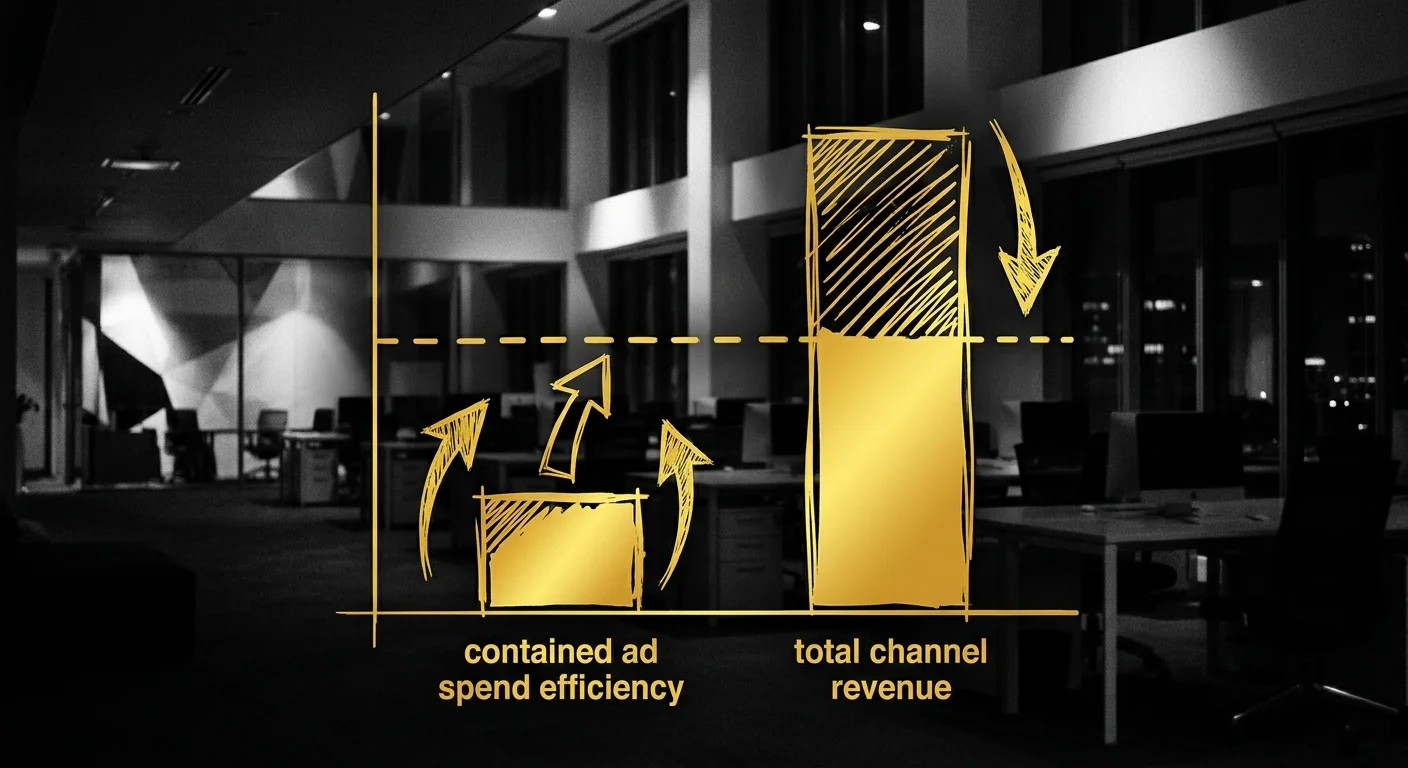
The agency model's flaw doesn't hide in the strategy deck. It shows up in the metric.
ACoS — Advertising Cost of Sale — measures how efficiently your ad spend generates ad-attributed revenue. That's it. It's a campaign metric. It tells you nothing about whether your Amazon channel is actually making money.
Here's the thing: a brand can have a perfect ACoS and a failing channel at the same time.
Amazon's average take rate per sale has reached 45% or more as of 2023, up from 35% in 2020. Typical FBA fee structures consume roughly 50% of the product's selling price before cost of goods is factored. When those costs sit outside the metric an agency is optimizing, they're invisible to the report.
But they are not invisible to the P&L.
TACoS — Total Advertising Cost of Sale measured against total channel revenue — is the number that tells the real story.
Measuring TACoS alongside ACoS shows what ad-level optimization can't: whether organic velocity is growing, whether the channel is building compounding returns, and whether the business behind the ad budget is actually healthy.
A rising ACoS with a falling TACoS means organic sales are growing faster than ad spend. That's a healthy channel. A low ACoS on flat TACoS means every dollar of revenue is bought. That's not growth — that's dependency.
The Metric Agencies Report vs. the Metric That Actually Matters
Agencies report ACoS because it's the only metric inside their control.
Bid adjustments move ACoS. Campaign structure moves ACoS. TACoS requires owning the full channel — inventory, compliance, fees, organic positioning. Most agencies don't own any of that.
So they don't report it.
That's not an accident. It's a structural consequence of the task model.
When an agency is accountable for ad spend and the brand is accountable for everything else — inventory, fees, compliance, unauthorized sellers — there's no single operator looking at total channel revenue. TACoS becomes nobody's number.
And a metric nobody owns is a metric nobody improves.
Brands figure this out the hard way. Usually after two or three quarters of clean ACoS reports sitting next to flat or declining margins.
At some point the questions change. They stop asking about bid strategy and keyword coverage. They start asking who is accountable for contribution margin — and what happens when that number moves in the wrong direction.
That shift in the question is exactly what leads them to evaluating their next channel partner.
How a Healthy ACoS Can Mask a Failing Channel
A low ACoS on a stagnant revenue base is not a win.
It's a warning sign. The channel has stopped growing organically. Every sale is ad-dependent. No compounding velocity is building. The brand is paying for the same customer acquisition repeatedly instead of earning repeat purchase.
Ad-spend optimization in isolation fails to capture total channel profitability. The number looks right. The channel isn't.
But the ACoS still looks good.
The average Amazon seller fees keep compounding in the background. The agency keeps sending the report. And the brand keeps approving a metric that describes what already happened — not what's actually going wrong.
That's not channel management. That's scorekeeping.
| Metric | What It Measures | What It Misses | Who Uses It as Primary KPI |
|---|---|---|---|
| ACoS (Advertising Cost of Sale) | Ad spend efficiency against ad-attributed revenue only | Organic revenue, total channel fees, inventory health, unauthorized seller impact, contribution margin | Traditional Amazon agencies optimizing campaign-level performance |
| TACoS (Total Advertising Cost of Sale) | Ad spend efficiency against total channel revenue — organic plus paid | Granular campaign-level bid performance when used alone | Channel operators accountable for full P&L outcomes |
| ROAS (Return on Ad Spend) | Revenue generated per dollar of ad spend | Profitability after Amazon fees, cost of goods, and fulfillment costs | Performance marketers focused on paid media ROI in isolation |
| Conversion Rate (CVR) | Percentage of listing visitors who purchase | Why traffic quality is low, whether listing suppression or unauthorized sellers are deflating demand signals | Listing optimization vendors and campaign managers |
| Session Count / Traffic Volume | How many shoppers reach a product detail page | Whether that traffic converts profitably or is driven by low-margin ad spend with no organic compounding | Agencies reporting visibility and awareness metrics to brand stakeholders |
| Contribution Margin per Unit | Net profitability per sale after all channel costs — fees, advertising, fulfillment, returns | Nothing — this is the metric that tells the real story of channel health | Amazon channel operators taking Full Operational Responsibility for the brand's P&L |
What Full Operational Responsibility Actually Means

Full Operational Responsibility means the operator owns every variable that determines whether the channel is healthy — not just the variables that show up in an ad dashboard.
All of them. Not a curated selection.
That scope is wider than most brands realize when they first hear it.
Advertising is one input. Inventory health, listing integrity, account compliance, unauthorized seller enforcement, and contribution margin are the others. An agency accountable for advertising alone cannot be accountable for outcomes that advertising alone does not control.
Those are different jobs. Most brands are paying for one and expecting the other.
Over 70% of enterprise consumer brands now report that Amazon's operational complexity requires integrated account custody — not simple ad-placement execution.
That's not a preference. It's a structural admission that the channel has outgrown the model most brands are still using to run it.
The Scope of Channel Ownership Beyond Advertising
Advertising is the most visible part of Amazon management. It produces reports. It has dashboards. It generates numbers that feel like progress.
That's exactly why agencies default to it. And exactly why brands over-index on it when the channel is quietly falling apart underneath.
But the work that actually protects a brand's Amazon position happens largely off-dashboard.
Inventory planning determines whether there is anything to sell when the ads work. Account compliance determines whether the account is in good standing when Amazon runs a policy review. Listing integrity determines whether the product detail page converting traffic is the one the brand built — or one modified by an unauthorized seller or a bad content merge.
Brands experience a 35% higher rate of stockouts and listing suspensions when agencies manage ads without owning inventory planning. That is what task-execution without full channel ownership produces.
A channel operator takes ownership of all of it.
Advertising efficiency measured against total channel revenue — not just ad-attributed sales. Inventory position maintained to prevent the stockouts that destroy organic rank. Listing quality monitored and defended. Account health managed proactively, not repaired after Amazon flags it.
Those aren't add-ons to good channel management. They are the channel.
Channel Defense: The Half of Amazon Management Most Agencies Skip
Most Amazon agencies pitch growth. Almost none pitch defense.
That gap isn't accidental. Defense is harder to report on, harder to attribute to a campaign, and harder to justify in a monthly deck. But channel defense is where established brands bleed margin — slowly, invisibly, with no line item that explains why.
The FTC's legal examination of Amazon's merchant ecosystem details the systemic impact of Amazon's mandatory fulfillment and search placement algorithms on seller margins.
The compliance environment on Amazon isn't static. It's actively contested, regularly updated, and consequential enough that the federal government is examining its structure.
Brands not actively managing compliance aren't safe because nothing has gone wrong yet. They're accumulating risk that surfaces as a suppressed ASIN or a suspended account — not as a warning in an agency report.
That is the half of Amazon management most brands are not getting.
Unauthorized seller removal. MAP enforcement. Account health monitoring. Listing integrity protection. Marketplace Valet treats channel defense as a prerequisite for growth — not an optional service tier.
And that is the structural difference between a partner taking Full Operational Responsibility for your Amazon channel and a vendor managing your ad spend inside it.
| Channel Function | Typical Agency Coverage | Channel Operator Coverage | P&L Impact if Neglected |
|---|---|---|---|
| Advertising Management | Managed — bids, campaigns, and ad-attributed ACoS | Managed against total channel revenue using TACoS as the primary accountability metric | Ad spend without channel context produces efficient-looking numbers on a declining P&L |
| Inventory Planning | Outside scope — brand retains ownership | Owned — inventory levels maintained to prevent stockouts that destroy organic rank | Stockouts collapse organic velocity and hand rank to competitors; recovery takes months |
| Listing Integrity | Partial — ad creative may be optimized; listing defense is not included | Owned — product detail pages monitored and defended against unauthorized edits and content merges | A corrupted listing converts less traffic regardless of how efficiently ads drive it |
| Account Health & Compliance | Reactive — addressed when a violation surfaces | Proactive — account health score monitored continuously before Amazon flags an issue | A suppressed ASIN or suspended account eliminates revenue instantly; repair takes weeks |
| Unauthorized Seller Enforcement | Outside scope — not an advertising function | Owned — MAP enforcement and unauthorized seller removal executed as ongoing channel defense | Unauthorized sellers train customers to expect lower prices, eroding brand equity and margin simultaneously |
| Contribution Margin Accountability | Not tracked — agency is accountable for ad spend, not channel P&L | Owned — every decision is evaluated against its impact on contribution margin, not ad-level efficiency | A channel can show healthy ACoS while fees, seller violations, and inventory costs quietly destroy profitability |
| Channel Strategy Ownership | Shared — agency executes; brand still makes strategic decisions | Unified — one operator holds accountability for the full channel outcome, eliminating handoff friction | Split accountability produces split results; no single party is responsible when the numbers diverge |
Who This Engagement Is — and Is Not — Built For
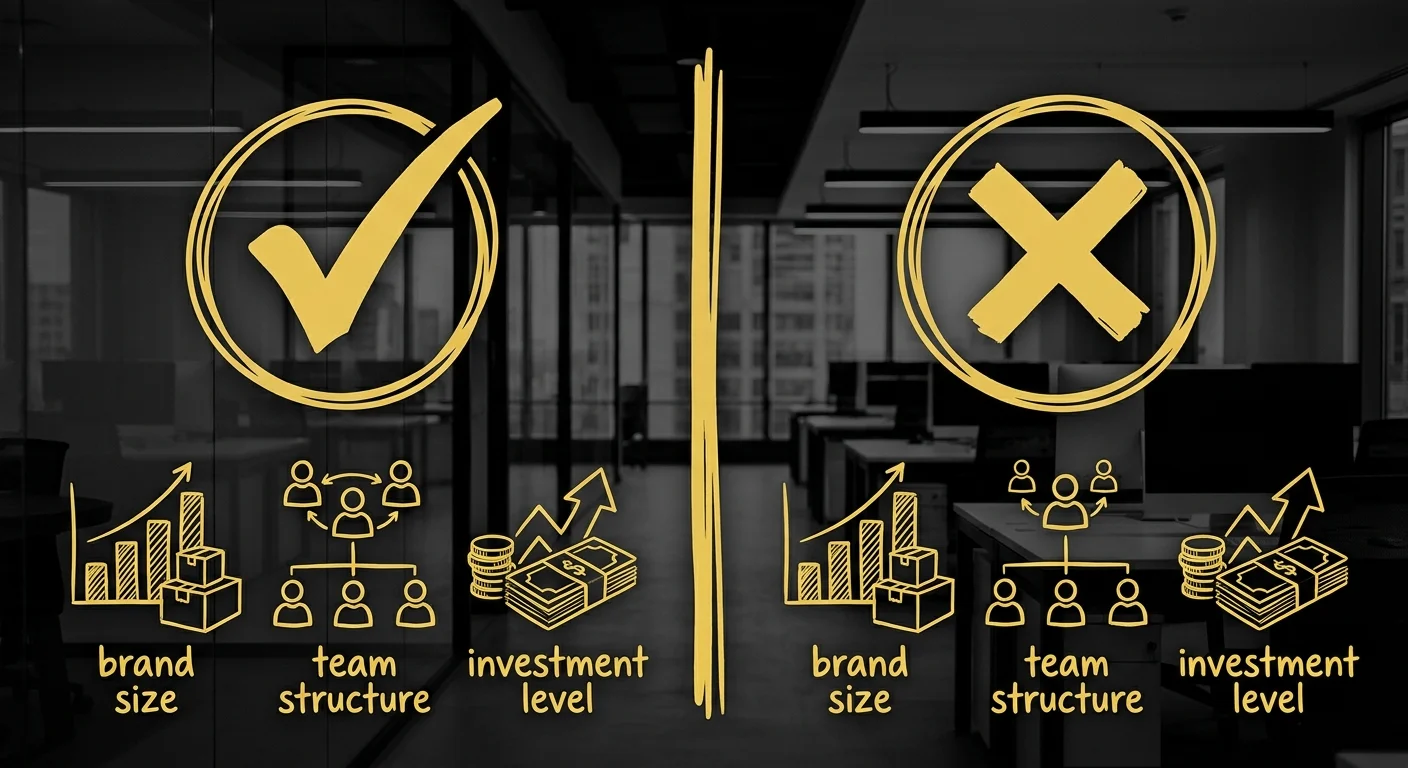
Not every brand is a fit for this model.
That is not a hedge. It is a qualification. Full Operational Responsibility demands a counterpart — a brand team that can own product decisions, fund the channel's economics, and let the operator run strategy without second-guessing every tactic.
The brands that get results here are established U.S. consumer brands with real Amazon revenue, real marketing budgets, and a leadership team that already learned the hard way.
Usually after one too many quarters of clean ACoS reports paired with flat margins.
They're not shopping for a vendor. They know the difference — and they've stopped pretending otherwise.
And the brands that don't fit need to know that before either side wastes time.
This isn't about ambition or revenue ceiling. It's about operational readiness — whether the brand's structure can actually hold this engagement. What that looks like in practice
The Brand Profile That Gets Results from This Model
The brands built for this engagement have already cleared the baseline. They have a product with market proof, an Amazon revenue base worth defending, and a leadership team that understands the channel's real cost structure.
When Amazon takes nearly half of each sale — average take rates reached 45% or more as of 2023, up from 35% in 2020 — protecting contribution margin requires an operator who knows those economics from the inside.
Not an agency running ad campaigns against them.
These brands have a real counterpart on their side. A marketing director, a VP of e-commerce, a C-suite decision-maker who can make brand calls fast and trusts the operator to execute without approval on every tactic.
That trust isn't passive.
It's an active recognition that hiring an expert to run the channel and then managing the expert gets you exactly the shipping-vendor results you were trying to escape.
They are also willing to fund the channel's realities. Typical FBA fee structures consume roughly 50% of the product's selling price before cost of goods is factored.
A brand entering or scaling on Amazon without a serious advertising budget and healthy inventory reserves is not ready for this engagement.
No amount of operational expertise compensates for the absence of channel economics.
Behaviors That Disqualify a Brand from This Engagement
So let's be direct about the other side.
Solo operators managing product strategy, marketing, and Amazon simultaneously aren't the right fit. This engagement requires a counterpart — a team that owns brand decisions — not a client who is also the operator.
When one person is playing every position, there's no one left to own the channel. That's not a solvable problem. That's a structural mismatch.
Brands whose decision-makers override strategy, redirect campaigns, or treat the operator as a button-pusher are a disqualification — full stop.
Brands experience a 35% higher rate of stockouts and listing suspensions when agencies manage ads without owning inventory planning. The same friction compounds when the brand itself fractures the operator's authority mid-engagement.
That's not a failed operator. That's a self-inflicted outcome — and no amount of expertise absorbs it.
Price shoppers evaluating this by hourly rate or line-item cost are the wrong fit.
The model is P&L accountability — not itemized execution. Brands shopping for the cheapest Amazon management won't extract value from this structure. They'll price-compare their way into the exact agency relationship they're already frustrated with.
That's not a loss. That's a qualification.
| Brand Characteristic | Right Fit | Wrong Fit |
|---|---|---|
| Amazon revenue base | Established revenue on Amazon worth defending — product has market proof and channel economics that justify full operational custody | No Amazon presence or a brand in early-stage testing with no baseline revenue to protect or grow |
| Decision-making structure | C-suite or VP-level counterpart who can make brand calls quickly and trusts the operator to execute strategy without approval at every tactic | Solo operator managing product, marketing, and Amazon simultaneously — no counterpart exists to own brand decisions |
| Advertising investment | Leadership that understands Amazon requires real advertising funding and has committed budget aligned to the channel's fee realities | Brand expecting revenue growth without meaningful advertising investment or unwilling to fund the channel's economics from launch |
| Relationship with expertise | Treats the operator as accountable for the channel — defers on strategy while staying informed on outcomes | Overrides strategy, redirects campaigns, or treats the operator as a button-pusher whose every move requires brand sign-off |
| Evaluation framework | Evaluates the engagement on P&L outcomes — contribution margin, channel profitability, and account health over time | Shops by hourly rate, line-item cost, or task volume — looking for the cheapest execution, not accountability for results |
| Engagement model | Committed to ongoing channel management as a long-term operational partnership with compounding returns | Seeking a one-time project, a short-term fix, or a trial engagement with an exit clause built into the mindset from day one |
| Compliance posture | Acknowledges that account health, listing integrity, and unauthorized seller exposure require active management — not passive monitoring | Believes the account is fine because no visible crisis has surfaced — treats the absence of a problem as evidence of a healthy channel |
How to Evaluate Whether Your Current Setup Is Actually Working

Most brands don't realize the channel is underperforming until the erosion is already compounding.
The reports look fine. The ACoS is respectable. Sales velocity hasn't collapsed.
But the P&L tells a different story. And nobody in the agency relationship owns the P&L.
That gap between what the dashboard shows and what the business is actually experiencing — that's the diagnostic.
TACoS — total advertising cost of sale measured against total channel revenue — offers a truer representation of organic growth and scaling efficiency than ad-level ACoS alone.
If your current setup is not measuring TACoS, it is not measuring channel health. It is measuring one input while the rest of the channel runs unmonitored.
The evaluation isn't complicated.
But it requires honesty most teams aren't ready for.
Ask who owns what. Then ask if the answer is actually true.
Five Signals Your Amazon Channel Is Running Without Real Accountability
Signal one: your reporting cadence has never once shown contribution margin.
Every monthly update covers ACoS, ROAS, sessions, and conversion rate. None of it tells you whether the channel is profitable after Amazon's fees, your advertising spend, and cost of goods.
That's not a reporting gap. That's an agency describing conditions while your margin erodes.
Signal two: inventory surprises that nobody flagged until they became a crisis.
Stockouts that tank organic rank. FBA capacity constraints that catch the brand off guard. Restock delays that compound for weeks before anyone surfaces them.
Over 70% of enterprise consumer brands report that Amazon's operational complexity requires integrated account custody — not siloed ad-placement execution. Inventory planning and advertising are not separate problems. Running them separately is what produces the failures.
Brands experience a 35% higher rate of stockouts and listing suspensions when agencies manage ads without owning inventory planning. That's the operational cost of the handoff model. It's measurable, and it shows up on the P&L.
Signal three: unauthorized sellers your team discovered by accident — not through active monitoring.
Signal four: an account health score that showed up as a surprise instead of a managed metric your operator was already watching.
Signal five — and the one that closes the loop — is brand leadership still triaging day-to-day Amazon problems they should never be touching.
When someone holds Full Operational Responsibility for the channel, your team isn't firefighting. They're running the business.
The Questions to Ask Before Your Next Agency or Operator Conversation
Before any conversation with a new agency or operator, run these questions against your current setup.
First: who is accountable if contribution margin declines while ACoS stays flat?
If the answer is unclear — or if the answer is you — the accountability structure is broken. That's not a minor gap. That's the whole problem.
Second: does your current partner own inventory planning, listing integrity, and account compliance — or do those live inside your team while the agency runs the ads?
That division is exactly where stockouts happen. It's where listings go dark without warning. It's where compliance violations compound before anyone sees them coming.
The weather reporter and the ship's navigator are looking at the same ocean. One of them is responsible for where the ship ends up. The other is just describing what the water looks like.
Third: when did your Amazon partner last raise a channel risk proactively — before it became a problem?
An operator with Full Operational Responsibility surfaces risks before they surface on their own. An agency that reports results after the fact is not running your channel.
It is describing what happened to it.
That distinction is the entire evaluation.
| Warning Signal | What It Looks Like | What It Actually Means | Urgency Level |
|---|---|---|---|
| Reporting never surfaces contribution margin | Monthly updates show ACoS, ROAS, sessions, and conversion rate — but never whether the channel is profitable after Amazon fees, advertising costs, and cost of goods | The agency is describing conditions on the channel, not navigating toward outcomes. Nobody in the relationship owns the P&L. | Critical |
| Inventory surprises catch the brand off guard | Stockouts, restock delays, or FBA capacity constraints that emerge as crises rather than flagged risks | Inventory planning and ad management are operating in separate silos. The operator does not own the full channel — and the handoff between functions is where margin disappears. | Critical |
| Unauthorized sellers discovered accidentally | Brand learns about listing hijackers, counterfeit offers, or MAP violations through customer complaints or routine browsing — not through proactive monitoring | Channel defense is absent from the engagement. The agency is managing growth inputs while brand equity erodes quietly in the background. | High |
| Account health score surfaces as a surprise | Warnings, policy violations, or ASIN suppressions appear without prior escalation from the agency | Compliance monitoring is not owned by the operator. The brand is absorbing compliance risk that a channel operator would have flagged and resolved before it became visible. | High |
| TACoS is never measured or discussed | Every advertising conversation centers on ACoS. Total channel revenue relative to total ad spend is never part of the reporting cadence. | The agency is optimizing one input in isolation. Organic velocity, channel health, and true scaling efficiency are unmonitored — and the brand has no visibility into whether the channel is actually growing or just spending. | High |
| Brand leadership still making day-to-day Amazon decisions | Executives are triaging listing issues, approving bid adjustments, answering agency questions about inventory levels, or resolving account flags themselves | The operator does not hold Full Operational Responsibility. The brand is still running the channel — it has simply added a vendor alongside its internal workload. | Moderate to Critical |
| No proactive risk escalation from the agency | The agency communicates reactively — reporting what happened in the last period, not surfacing what the brand should address before it becomes a problem | This is the weather reporter versus the navigator distinction. Reactive reporting is not channel management. It is a description of conditions the brand is already living with. | Definitive |
Frequently Asked Questions
These are the questions brands ask after the argument lands — but before they've made the move.
Edge cases. Objections. The gap between knowing something is true and acting on it.
Answer each one against your current setup.
Where the answers get uncomfortable — that's the diagnostic.
What is the core difference between an Amazon agency and an Amazon channel operator?
The difference is not scope. It is accountability.
An agency is responsible for deliverables — campaigns, listing updates, monthly reports. When something goes wrong on the channel, the agency documents it. The brand is still responsible for fixing it.
A channel operator takes Full Operational Responsibility for the entire Amazon P&L — advertising, inventory health, listing integrity, account compliance, and channel defense. When something goes wrong, the operator surfaces it before the brand does. And the operator owns the resolution.
The brand's leadership is not managing the channel. They are running the business.
That is not a subtle distinction. It is the entire difference between a reporting relationship and an operating one.
Why do traditional Amazon agencies focus on ACoS instead of TACoS?
Because ACoS is the metric agencies can control — and it's the one clients ask about.
ACoS measures how efficiently your ad budget generates ad-attributed revenue. Real number. Incomplete number. It tells you nothing about organic velocity, nothing about unauthorized sellers eroding your pricing, and nothing about whether the channel is actually profitable after Amazon's fees and cost of goods.
TACoS — total advertising cost of sale measured against total channel revenue — tells the real story. A brand with a rising ACoS but a falling TACoS is building organic momentum. A brand with a clean ACoS on flat revenue isn't building anything.
Agencies report what they're asked to report. Operators track what determines whether the channel is healthy.
Those aren't the same job.
How does a channel operator handle Amazon inventory and compliance issues that an agency wouldn't?
A channel operator owns inventory planning as part of the engagement. Not as a separate logistics problem the brand solves while the operator handles ads.
That integration is what eliminates the handoff gap. Brands experience a 35% higher rate of stockouts and listing suspensions when agencies manage ads without owning inventory planning. That number is the direct cost of split ownership — when nobody is watching the space between ad performance and restock timing.
On compliance, the difference is proactive versus reactive.
An operator with Full Operational Responsibility monitors account health scores, unauthorized seller activity, ASIN suppression risks, and listing integrity as a continuous function — not as a crisis response. The FTC's legal examination of Amazon's merchant ecosystem underscores why this matters: Amazon's fulfillment and search placement algorithms impose real margin consequences when compliance is managed passively.
An operator surfaces those risks before they surface on their own.
What are the most common failure points when brands try to manage Amazon strategy in-house?
The most common failure is a leadership team still making channel decisions they hired someone else to make.
The moment an internal team starts overriding strategy, redirecting campaigns, or requiring sign-off on individual tactics — the operator's authority fractures. The results fracture with it.
The second failure is split ownership. Marketing owns brand positioning. Operations owns inventory. Someone manages the agency relationship. Nobody owns the P&L across all three. Over 70% of enterprise consumer brands report that Amazon's operational complexity requires integrated account custody — not simple ad-placement execution. Split ownership is the structural reason that number exists.
The third failure is underfunding the channel and expecting expertise to compensate. Institutional Discipline applied to an underfunded channel still produces a constrained outcome.
The economics have to be there before the strategy can perform.
How do I know if my current Amazon setup is actually producing P&L results or just reporting metrics?
Start with one question: does your monthly reporting ever mention contribution margin?
If every update covers ACoS, ROAS, sessions, and conversion rate — but never addresses whether the channel is profitable after Amazon's fees, advertising costs, and cost of goods — you're getting a weather report. Not navigation.
Second check: inventory surprise. Stockouts, restock delays, and FBA capacity constraints that catch your team off guard aren't logistics problems. They're symptoms of operational ownership sitting on the wrong side of the relationship.
Third check: unauthorized seller exposure. If you found out about unauthorized sellers accidentally — rather than through a proactive flag from your partner — the channel defense function isn't there.
If your current setup isn't tracking TACoS across total channel revenue, it's measuring one input while the rest of the channel runs unmonitored. Over 70% of enterprise consumer brands report the channel requires integrated account custody — not ad-placement execution. Brands carry a 35% higher rate of stockouts and listing suspensions when agencies manage ads without owning inventory planning.
That's reporting. P&L accountability looks different — and it feels different.
How does the transition work when moving from a traditional Amazon agency to a channel operator?
It starts with a full account audit — not a sales pitch.
Before any engagement begins, the operator needs to understand the current state of the channel: advertising structure, listing health, account compliance, inventory patterns, unauthorized seller exposure. That audit is the baseline. It's also proof that the operator understands the channel before claiming responsibility for it.
From there, the engagement is built around transferring operational ownership — not layering a new vendor on top of the existing setup. The brand's internal team hands off day-to-day channel decisions. The operator takes them on with Full Operational Responsibility.
The transition requires one thing from the brand's side: a counterpart who can make brand decisions quickly and trusts the operator to execute without sign-off at every tactical step.
That trust isn't built on faith. It's built on the audit findings, the operator's documented methodology, and a clear understanding of who owns what — from day one.
The Channel Doesn't Run Itself
The channel doesn't run itself.
That's not a tagline. It's what every brand figures out eventually — usually a quarter after the reports looked clean and the P&L said something different.
A weather reporter and a ship's navigator are both watching the same ocean. One is steering. One is describing conditions.
Right now, one of those two people is running your Amazon channel.
The question isn't whether to invest in Amazon management. Brands at this level are already investing.
The question is what that investment actually buys.
Full Operational Responsibility means someone owns the P&L, defends the channel, and surfaces risk before it becomes a crisis. The alternative produces reports. One of those outcomes compounds over time. The other one just narrates the compounding.
That's the whole choice.
Brands that want to know more about us — our methodology, our intake standards, who we actually take on — already know what question comes next.
Not about deliverables. About accountability. Who owns the outcome when the report and the P&L stop agreeing.
The brands that ask that question clearly are the ones that stop losing revenue they never see leaving.
If the reports look fine but the P&L tells a different story — that's not a channel problem. That's an ownership problem. One is steering. One is just describing conditions. Marketplace Valet offers a free Amazon account audit: a 15–20 page review of your specific channel covering advertising structure, listing health, account compliance, and unauthorized seller exposure, delivered within 3–5 business days. Not a pitch. A diagnostic. The findings are yours regardless of what comes next.