
How Full Channel Management Redefines Brand Oversight
Full channel management is the operational model in which a single accountable partner assumes responsibility for every function that determines whether an Amazon channel is profitable — advertising efficiency, price protection, listing integrity, and supply chain alignment — measured against P&L outcomes rather than individual metric performance.
Most brands don't have that. They have an agency running ads, someone internal fielding compliance questions, and leadership reviewing a dashboard that may or may not reflect what the channel actually costs. That fragmentation is the problem. When no single operator owns the full picture, margin leaks through the gaps — rising ad spend not offset by organic velocity, unauthorized sellers eroding pricing integrity, listing errors suppressing organic visibility. None of those failures show up cleanly on a single-metric report. It's a clean dashboard on a bleeding channel.
Full channel management replaces fragmented task execution with unified accountability. Advertising decisions are made in the context of total channel revenue — not isolated campaign efficiency. Brand protection and MAP enforcement run continuously, not reactively. Inventory and supply chain alignment supports listing health rather than undermining it. Listing content, accuracy, and compliance are maintained as operational assets, not one-time projects.
Third-party sellers now drive approximately 60% of Amazon's gross merchandise value, and retail media ad spending has surpassed $50 billion annually. Brands that treat Amazon as a simple marketing channel — optimizing a few campaigns and checking a dashboard — are operating without the full view the channel now demands. CPG brands that successfully optimize their full marketplace operations can drive up to 30% revenue growth. The difference between those brands and the ones bleeding margin invisibly is rarely talent. It's structural accountability.
Last Updated: June 11, 2026
- • What Brand Oversight Actually Means on Amazon
- • The Four Operational Pillars of Full Channel Management
- • Who This Engagement Is — and Is Not — Built For
- • Making the Transition: What a Channel Management Handoff Actually Looks Like
-
• Frequently Asked Questions
- • How do integration friction points occur when migrating from an in-house manager to a full channel management model?
- • Why do conventional Amazon agencies fail to address unauthorized sellers and MAP erosion under standard contract structures?
- • What are the realistic time and cost implications of establishing proper channel defense versus ignoring unauthorized sellers?
- • If our brand expects close oversight, why does micromanaging daily bid adjustments degrade overall channel performance?
- • How does transition latency affect inventory and listing health during the first 30 days of a channel management handoff?
- • What is the difference between TACoS and ACoS, and why does it matter for evaluating agency performance?
- • The Only Metric That Actually Matters Is Whether the Channel Is Profitable
What Brand Oversight Actually Means on Amazon

Most brands think oversight means visibility. A dashboard. A weekly report. A monthly call where the agency walks you through numbers that all point up.
That's not oversight. That's observation.
Real oversight means owning the P&L consequence of every decision made on the channel — not just the metric that decision was supposed to move.
There's a gap between those two things. Most brands are living in it.
The McKinsey retail framework is unambiguous: CPG brands that optimize their full marketplace operations can drive up to 30% revenue growth.
The operative word is full. Not one campaign. Not one function. The entire channel, coordinated under one accountable operator.
That's what Marketplace Account Management looks like when it's built correctly — not a collection of managed tasks, but a single operating model where every function feeds the same P&L.
Most brands assume their current setup delivers this. It doesn't. what full channel management actually requires
The Dashboard Lie Most Brands Are Living
Here's the thing about dashboards: they're built for comfort, not truth.
They surface the metrics that are easiest to explain — ACoS, session count, conversion rate. They quietly omit the numbers that would tell you whether the channel is actually healthy.
An advertising dashboard can look perfect while organic ranking collapses underneath it. Digital shelf execution errors cause a critical drop in organic visibility — and that loss doesn't send an alert.
It erodes over weeks. The ad report stays green. The channel doesn't.
That's the clean dashboard, bleeding channel problem.
The report looks fine. The P&L doesn't. And because no single person owns both simultaneously, nobody connects the dots until the damage is already compounded.
Why Metric-Only Agency Models Break Down
Metric-only agency models don't break down because of weak talent. They break down because of structure.
When an agency is accountable for a metric — ACoS, keyword ranking, conversion rate — it optimizes for that metric. Not for what the metric was supposed to represent.
ACoS is supposed to represent advertising efficiency. But an agency can produce a low ACoS on a shrinking revenue base and technically hit its target.
The metric passes. The channel fails. That's not bad execution — it's a broken accountability structure.
The same pattern plays out across every function that operates in a silo.
A listing team optimizes content but doesn't own inventory alignment. So a perfectly written listing goes out of stock and loses rank — and no one on the listing team is accountable for that outcome. An ad team cuts spend to hit efficiency targets without accounting for the organic velocity that spending was building. Each team hits its number. The channel still bleeds.
Full Operational Responsibility is the antidote to all of it.
One operator. One outcome. Not a deliverable, not a metric — the outcome. That single structural shift is what separates brands that compound returns on Amazon from brands that generate reports about why they didn't.
| Oversight Signal | What Agencies Typically Report | What Full Channel Management Tracks |
|---|---|---|
| Advertising Performance | ACoS, impression share, CTR by campaign | TACoS against total channel revenue — organic velocity included |
| Pricing Integrity | Buy Box win rate as a standalone metric | MAP compliance across all active sellers, including unauthorized third parties |
| Listing Health | Conversion rate and session count | Listing suppression risk, content accuracy, and compliance status against Amazon policy |
| Inventory Alignment | In-stock rate or FBA inventory level | Inventory position relative to ad spend, rank trajectory, and replenishment lead time |
| Channel Profitability | Revenue and units sold | Contribution margin after Amazon fees, ad spend, storage costs, and return rates |
| Accountability Model | Deliverable completion and metric targets hit | P&L outcome — single operator owns the consequence, not the report |
The Four Operational Pillars of Full Channel Management
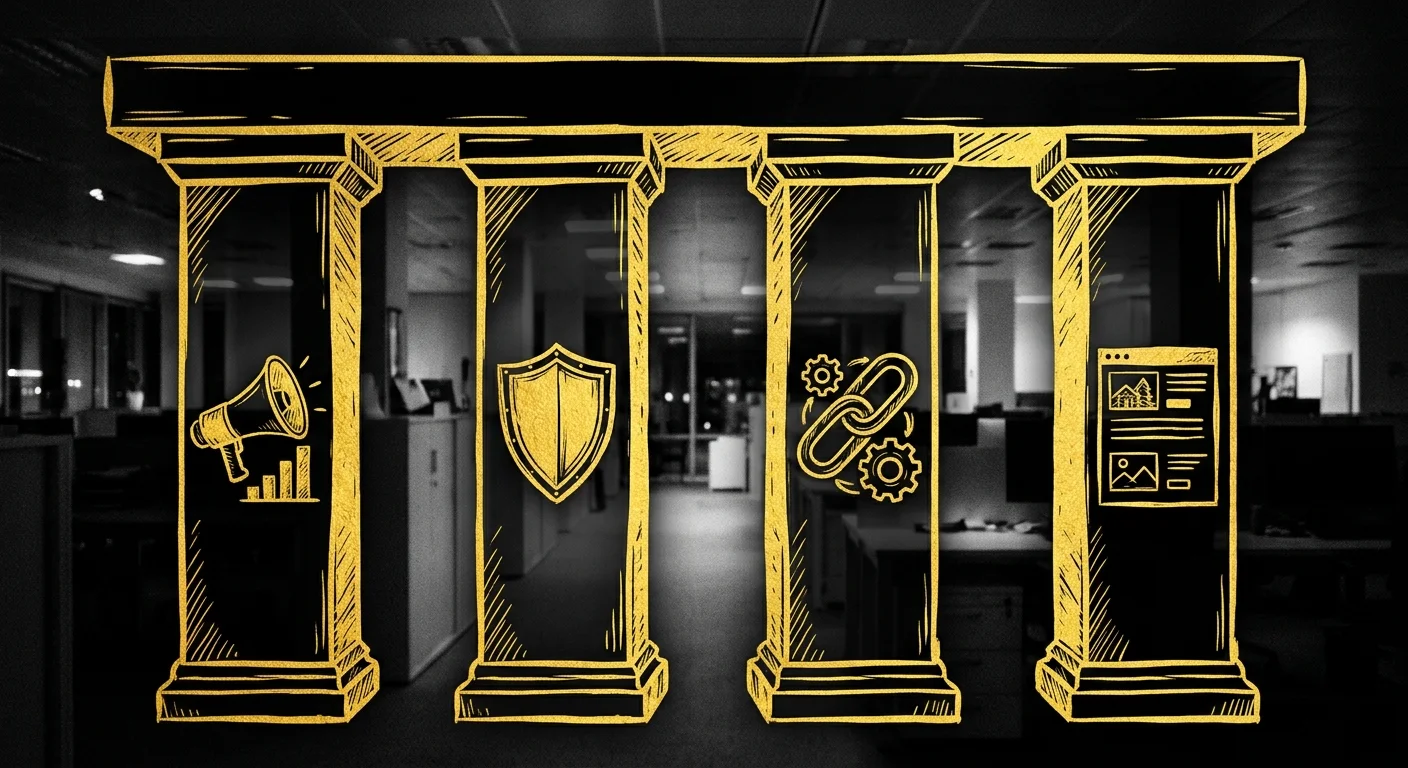
The fix isn't better reporting. It's structure.
Four operational pillars constitute genuine full channel management. Each one addresses a category of margin leakage that isolated task execution consistently misses.
These aren't service features. They're the four functions that determine whether an Amazon channel is actually profitable.
Separate them, and the gaps between them become the leaks.
The Harvard Business Review channel analysis identified this dynamic long before Amazon existed: misalignment between distribution functions and marketing execution compromises brand integrity.
That structural truth hasn't changed. It's only gotten more expensive to ignore. And the hidden costs of in-house Amazon management are measurable — in margin, in rank, and in brand equity that doesn't come back.
Advertising TACoS: The Metric That Tells the Real Story
Most brands are optimizing the wrong advertising metric.
ACoS tells you how efficiently your ad spend generated ad-attributed revenue. That's it. It tells you nothing about whether the channel is actually growing.
Advertising TACoS Discipline — Total Advertising Cost of Sale measured against total channel revenue — is the metric that tells the real story.
A brand with rising ACoS but falling TACoS is building organic velocity. A brand with low ACoS on a flat revenue base is not building anything. Those are not the same situation. Reporting ACoS in isolation won't tell you which one you're in.
Retail media ad spending has surpassed $50 billion annually. The cost of optimizing the wrong metric compounds faster than it ever has.
An agency accountable only for ACoS will optimize ACoS. That's not a talent problem. It's a structural one.
Advertising TACoS Discipline means advertising decisions are made in the context of total channel revenue — not isolated campaign efficiency. When that accountability is missing, the ad report looks fine. The P&L doesn't.
Channel Defense: Price Protection and Unauthorized Seller Removal
Strong products attract unauthorized sellers faster than weak ones.
That's not intuitive. But it's consistently true. And it's why Channel Defense isn't an optional add-on — it's a prerequisite for protecting the revenue a brand has already earned.
Unauthorized marketplace sellers and counterfeit activity cost consumer brands billions of dollars annually in eroded margins, according to the Department of Homeland Security report on piracy.
That figure doesn't capture the harder-to-measure damage. The customer who buys a counterfeit, has a bad experience, and never comes back to the brand.
The margin erosion is visible. The brand erosion isn't.
Third-party sellers now drive approximately 60% of Amazon's gross merchandise value.
That's not a channel where a brand can afford to run defense reactively. By the time an unauthorized seller appears on a brand's radar, they've already trained customers to expect a lower price.
Channel Defense means MAP enforcement, unauthorized seller removal, and account compliance monitoring run continuously.
Not as a crisis response. As standard operating procedure.
Most agencies don't talk about this because they're not accountable for your brand. They're accountable for your ad spend.
Supply Chain Alignment and Listing Integrity
Supply Chain Alignment and Listing Integrity are the two pillars brands most often treat as support functions.
They're not. They're the operational foundation everything else runs on.
A perfectly written product detail page means nothing if the ASIN is out of stock.
Inventory health directly affects organic ranking. Amazon's algorithm doesn't distinguish between a suppressed listing and a poorly optimized one. Both lose rank.
Supply Chain Alignment means inventory decisions are made with an understanding of their downstream effect on listing visibility and advertising efficiency. When supply chain and advertising operate in separate lanes, the cost is invisible until the rank is already gone.
Listing Integrity is the difference between a product detail page that converts and one that quietly loses ground.
Unauthorized content changes, compliance flags, copy that hasn't been updated to reflect the current competitive environment — these aren't dramatic failures. They're slow ones.
It's not a one-time project. It's ongoing operational discipline. And when it's not owned by someone accountable for the P&L outcome, it drifts — quietly, consistently, expensively.
| Channel Management Pillar | What It Controls | What Breaks Without It |
|---|---|---|
| Advertising TACoS Discipline | Total advertising cost measured against total channel revenue — not isolated campaign efficiency | Ad reports show healthy ACoS while organic velocity stagnates; the channel looks efficient and stops growing simultaneously |
| Channel Defense | MAP enforcement, unauthorized seller removal, and ongoing account compliance monitoring | Unauthorized sellers erode pricing integrity; customers are trained to expect a lower price; brand equity degrades invisibly while the ad dashboard stays green |
| Supply Chain Alignment | Inventory decisions made with direct awareness of their effect on listing rank and advertising efficiency | Out-of-stock ASINs lose organic rank; ad spend builds velocity on a listing that disappears; recovery takes longer than the original loss |
| Listing Integrity | Ongoing accuracy, compliance, and competitive relevance of every product detail page | Unauthorized content changes, compliance flags, and outdated copy accumulate undetected; conversion rate drifts down without a visible trigger |
Who This Engagement Is — and Is Not — Built For

Not every brand belongs here. That's not a hedge — it's a design feature.
Full Operational Responsibility requires a specific kind of counterpart. A brand with real marketing infrastructure, real advertising budget, and a leadership team that can own brand decisions — without also trying to own channel execution. The operator leads the channel. The brand leads the brand. Those two lanes have to stay separate, or neither functions correctly. That's the structural question at the center of the comparison of in-house versus agency operational models — and it's the first question every brand should answer before evaluating fit.
The qualification gate isn't about revenue. It's about posture. Brands ready to hand accountability to an operator — and trust the strategy that comes with it — get compounding returns. Brands that aren't ready produce friction. And that friction degrades results the same way margin erosion does: quietly, then all at once.
The Brands That Get Maximum Value From This Model
The brands that get maximum value here have already hit the ceiling. They've maxed out what self-management or a task-execution agency can produce. They know something is wrong with the channel. They just haven't had a single operator accountable for finding it — and fixing it.
These are established U.S. consumer brands — typically at $1M or more in annual Amazon revenue, or brands with the product and distribution infrastructure to get there. Their leadership has better uses for its time than operating the channel daily. They have real advertising budgets, real catalog depth, and a compliance environment complex enough that execution errors on the digital shelf create a critical drop in organic visibility, per Gartner research on digital shelf execution. They've felt that cost. Most haven't named it yet.
These brands aren't shopping for reports. They're looking for an operator who owns the outcome — someone who sees the clean dashboard, bleeding channel problem simultaneously and is accountable for closing the gap. That's what this model is built to deliver.
Why Some Brands Are Not the Right Fit
But specific behaviors disqualify a brand from this engagement. Not attitudes. Behaviors.
If a brand's leadership needs to approve every bid adjustment and every content change, the oversight required will degrade the results we can produce. Full Operational Responsibility means the operator owns the channel strategy. That can't be split between two parties. One leads. One trusts. When both try to lead, neither does — and the channel pays for it.
Price shoppers aren't the right fit either. This model is P&L accountability — not itemized task execution billed by the hour. Brands evaluating agencies on cost per deliverable won't find value here, and they won't stay. Unauthorized sellers and counterfeit activity already cost consumer brands billions annually in eroded margins — and the brands most exposed are almost always the ones who deprioritized channel investment, then watched the cost compound. The hidden costs of in-house Amazon management follow a predictable pattern. That pattern doesn't stop because a brand found a cheaper agency.
Solo operators, brands looking for short-term project work, and brands that want Marketplace Valet to execute while they keep the strategy — none of these are candidates. This model requires a partner. Not a client who is also the strategist.
| Brand Profile | Signals This Is the Right Fit | Signals This Is Not the Right Fit |
|---|---|---|
| Established U.S. consumer brand with real catalog depth | Annual Amazon revenue at or approaching $1M+; multi-SKU catalog with existing brand infrastructure | Single-product or early-stage brand with no marketing budget or brand infrastructure |
| Leadership team ready to hand off channel execution | Brand decision-makers want to own brand strategy — not daily Amazon operations; willing to trust the operator's methodology | Leadership needs final approval on every bid adjustment, content change, or tactical decision |
| Real advertising investment available | Committed to funding advertising aggressively; understands that demand signals require capital investment to build | Unwilling to invest in advertising; expects organic results without advertising infrastructure |
| Operational posture aligned with P&L accountability | Evaluates agency performance by channel contribution margin and TACoS trajectory — not vanity metrics or hourly task output | Evaluates agencies by cost per deliverable or line-item billing; shopping for the cheapest execution |
| Compliance environment with real risk exposure | Active or potential unauthorized seller problem; MAP enforcement gaps; account compliance complexity that requires dedicated operational oversight | Brand has never experienced compliance friction and believes an active channel defense program is unnecessary |
| Engagement model compatible with ongoing management | Ready for a long-term channel management partnership with compounding returns over time | Looking for a one-time audit, a short-term project, or a vendor to execute discrete tasks without strategic ownership |
Making the Transition: What a Channel Management Handoff Actually Looks Like

Knowing you need a full channel management partner is step one.
Actually making that transition — without losing ground in the process — is where most brands hesitate. So here's what it looks like.
This is not a single handover meeting. It runs across three distinct phases, each with a specific job.
How much it disrupts your operation depends almost entirely on how organized your account history is when the engagement starts. Messy history adds time. Clean history doesn't.
US retail media ad spending has already surpassed $50 billion annually, per eMarketer retail media projections. The window for building organic velocity on Amazon is not holding open indefinitely.
Brands that delay because they're nervous about short-term disruption are making a trade. Known friction now — or invisible compounding cost every month the channel underperforms.
That's not a close call.
The First 30 Days: Audit, Access, and Baseline
The first 30 days aren't about running campaigns.
They're about finding out what the brand actually owns — and what's been quietly eroding it.
Access comes first.
Seller Central credentials, advertising account access, brand registry, and any existing vendor relationships all get mapped and transferred. Brands with messy account hygiene — multiple undocumented users, orphaned campaigns, access nobody remembers granting — add real time to this step.
That's not a criticism. It's what reactive account management looks like after a few years.
Then the audit runs.
This is what separates a real handoff from a reporting swap. Listing Integrity gaps, unauthorized seller exposure, advertising campaign structure, inventory health, account compliance flags — all of it gets mapped. By day 30, the operator has a full baseline: what the channel actually looks like, what it's actually costing, and where the margin is leaking.
That baseline is the foundation. Everything in the next phase builds from it. this vetting checklist
Days 31–90: Structural Corrections and Advertising Realignment
Days 31 through 90 are where the structural corrections happen.
This is also the phase where brands that haven't fully bought into the model start creating friction. That friction slows results for both parties.
Channel Defense actions start here — unauthorized seller removal, MAP enforcement, compliance corrections. Advertising campaigns get rebuilt around Advertising TACoS Discipline: campaigns that were optimizing ACoS in isolation get restructured to track total channel revenue instead.
Supply Chain Alignment reviews begin in parallel.
The goal isn't to fix everything at once. The goal is to stop the active bleeding — and establish the operational baseline that the next phase builds on.
CPG brands that execute this kind of marketplace realignment can drive up to 30% revenue growth, according to the McKinsey retail framework for marketplace optimization.
That number doesn't come from a single tactic. It comes from all four pillars running under one accountable operator — and it starts here, in the corrections phase.
Not at launch. Not after 90 days. Here.
The 90-Day Mark and Beyond: Full Operational Responsibility
By day 90, the engagement shifts into Full Operational Responsibility.
The operator isn't correcting legacy problems anymore. They're building forward.
This is where the clean dashboard, bleeding channel problem finally gets solved.
The dashboard starts reflecting the channel's actual health — because one operator is accountable for all of it simultaneously. Advertising TACoS Discipline, Channel Defense, Supply Chain Alignment, and Listing Integrity are no longer running in separate lanes with no one watching the gaps between them.
Those gaps — the ones generating invisible losses — are now owned.
The brands that get the most from this model stayed the course through days one through ninety.
The transition cost is real. The compounding return on the other side of it is also real.
One of those costs is visible. The other one builds quietly — in the right direction.
| Transition Phase | Primary Activities | What Gets Resolved | Typical Timeline |
|---|---|---|---|
| Days 1–30: Baseline Audit | Account access transfer, Seller Central and advertising credential mapping, full diagnostic audit covering Listing Integrity gaps, unauthorized seller exposure, campaign structure, inventory health, and compliance flags | A complete channel baseline — what the channel actually looks like, what it's costing, and where the margin leaks are hiding | First 30 days |
| Days 31–90: Structural Correction | Channel Defense actions initiated (unauthorized seller removal, MAP enforcement), advertising campaigns rebuilt around Advertising TACoS Discipline, Supply Chain Alignment reviews, compliance corrections executed | Active margin bleed stopped; legacy campaign structure replaced; operational baseline established for compounding forward | 30 to 90 days |
| Day 90+: Full Operational Responsibility | All four pillars — Advertising TACoS Discipline, Channel Defense, Supply Chain Alignment, and Listing Integrity — running in coordination under a single accountable operator; forward strategy replaces legacy correction | The 'clean dashboard, broken channel' gap closes; the channel's reported health reflects its actual health | Ongoing engagement |
Frequently Asked Questions
Most brands this close to a decision have the same three or four questions. Here are the ones that actually matter.
How do integration friction points occur when migrating from an in-house manager to a full channel management model?
Most of the friction is structural, not strategic. Undocumented access, orphaned campaigns, multiple users with no clear ownership — that's what slows a handoff down.
But here's the harder truth: brands that ran Amazon reactively don't have a clean baseline. They have a history of decisions no one documented.
The first 30 days will surface problems that weren't visible before. That's not the agency failing. That's the first time anyone actually looked.
Why do conventional Amazon agencies fail to address unauthorized sellers and MAP erosion under standard contract structures?
Because most agencies aren't contracted for outcomes. They're contracted for tasks — run the ads, refresh the listings, file the reports.
Unauthorized seller removal and MAP enforcement aren't line items in a task model. They only matter to someone accountable for your P&L. Most agencies aren't.
Third-party sellers drive roughly 60% of Amazon's GMV. That's the environment your brand operates in every day. An agency optimizing ACoS wasn't built to protect you from it.
What are the realistic time and cost implications of establishing proper channel defense versus ignoring unauthorized sellers?
Unauthorized sellers cost consumer brands billions annually in eroded margins. That's not a forecast. That's what's happening right now on accounts with no active enforcement.
Ignoring it doesn't hold the cost flat. It compounds. Every month without MAP enforcement trains your customer to expect the lower price — and once that expectation is set, it doesn't reset when you fix the listing.
Channel defense takes investment — time, process, operator attention. Brands that delay it don't save anything. They just push a larger problem into the next quarter.
If our brand expects close oversight, why does micromanaging daily bid adjustments degrade overall channel performance?
Close oversight is appropriate. Micromanagement is a different thing entirely.
When a brand requires approval on every bid change, the operator can't act on real-time data. Campaigns slow down. Results follow.
Full Operational Responsibility requires one decision-maker on strategy. That's not a contract clause — it's how effective channel management works. A brand that hires an operator and then operates the operator gets task-execution results. Not channel results.
How does transition latency affect inventory and listing health during the first 30 days of a channel management handoff?
Transition latency is real. Access delays, credential gaps, account structures no one documented — all of it slows the first 30 days.
When the operator can't get in fast, listing health drifts. Campaigns run without anyone watching. Inventory signals go unread. The problems you hired someone to fix keep compounding while the keys are still being passed.
The brands that move through it fastest did one thing differently: they cleaned up account hygiene before the engagement started. Not after.
What is the difference between TACoS and ACoS, and why does it matter for evaluating agency performance?
ACoS measures how efficiently your ad budget generated ad-attributed revenue. That's all it measures. It tells you nothing about organic velocity or total channel profitability.
Advertising TACoS Discipline measures total ad spend against total channel revenue — including organic. It shows whether your channel is building or just spending. Those aren't the same thing.
Retail media ad spending has surpassed $50 billion annually. In that environment, optimizing ACoS in isolation while TACoS climbs isn't a strategy. It's a reporting habit that hides a performance problem.
The Only Metric That Actually Matters Is Whether the Channel Is Profitable
Here's what a clean dashboard hides: the channel is bleeding.
ACoS is low. Sessions are up. Nobody's flagging anything.
And underneath all of it, unauthorized sellers are eroding your pricing, Listing Integrity is drifting, and advertising spend is quietly disconnecting from total channel revenue. That's not a reporting problem. That's an accountability problem.
Full Operational Responsibility means one operator owns all four pillars at once — Advertising TACoS Discipline, Channel Defense, Supply Chain Alignment, and Listing Integrity. Not as separate functions handed to separate vendors. As a coordinated system with one outcome: whether the channel is actually profitable.
That's the only metric that matters.
Everything else is noise that looks like signal until the P&L tells a different story.
The brands that move on this aren't the ones who found a better agency pitch. They're the ones who got tired of a clean dashboard on a bleeding channel — and decided the P&L was the only scorecard worth trusting.
Marketplace Valet was built for that brand.
The question isn't whether your Amazon channel needs this. The question is how much longer you're willing to find out the hard way that it did.
Here's what a flat dashboard actually tells you: nothing useful. Flat isn't healthy. Flat means no one's looking hard enough. If your P&L looks fine but you haven't checked unauthorized seller exposure, TACoS drift, or whether Channel Defense is even running — you don't have oversight. You have a gap you haven't found yet. A 15–20 page Amazon account review tells you exactly where the margin is leaking and what's missing. Submit your account for a full account review — the findings are yours regardless of what comes next.