
Why Amazon Re-Measures Your SKUs and How to Correct Errors Fast
Amazon re-measures SKUs because the weight and dimensions it has on file set each product’s size tier, and the size tier sets the FBA fee on every unit. To correct an error fast, ask for a remeasurement in Seller Central, then file a separate reimbursement request for fees already charged. Measurements come from sensors in Amazon’s fulfillment centers, and those sensors read packaging edge to edge. Loose poly bag material or a handle sticking out gets counted as part of the package, so the product is recorded as bigger than it is. Items near a size-tier line are most exposed, because a small error can push them into a higher fee tier. A remeasurement request should come with the product’s real packed dimensions. Amazon then rescans the unit, and its own measurement decides the outcome. If the new figure is lower, fees drop going forward. Past overcharges are not refunded on their own. They need their own claim, filed before that claim’s window closes. Fees keep billing against whatever measurement is on file, so an uncorrected error grows with every unit sold.
Last Updated: October 24, 2026
- • What Actually Happens When Amazon Re-Measures a SKU
- • Why a Single Measurement Event Can Reshape Your Entire Fee Structure
- • Where the Numbers Go Wrong
- • The Packaging Variables Sellers Control
- • Why 'Set and Forget' Dimension Management Fails
- • The Correction Pathway Step by Step
-
• Frequently Asked Questions
- • How often can I ask Amazon to re-measure the same SKU?
- • What is the best way to package my products to avoid dimension errors by Amazon?
- • Can I get reimbursed for past FBA fees if I find a measurement error today?
- • How long does it typically take for Amazon to process a re-measurement request and apply corrections?
- • Do corrected dimensions carry over to other Amazon marketplaces?
- • Where This Leaves You
What Actually Happens When Amazon Re-Measures a SKU

Every FBA fee starts from a measurement. And that measurement doesn’t vanish into a file once it’s taken.
It becomes the input every fulfillment fee on that SKU gets calculated against, until something forces a second look.
The First Reading Sets the Fee
The first reading matters most because nothing came before it. Whatever the packed unit looks like when it reaches the fulfillment center is what gets recorded.
That’s why accuracy at intake matters more than most sellers assume. Get the packaging wrong on day one, and the error isn’t a one-time mistake.
Why Previously Stored Items Get Re-Measured Too
But intake isn’t the only time a figure can change. A SKU that’s sat in inventory for months can still show a new measurement, and a seller can ask for a rescan too.
When a seller’s figure and the fulfillment center’s disagree, the packing material is the usual cause, according to a reply on Amazon’s U.S. Seller Forums. A changed bag, a new insert or a different carton can all move the number. Operators who track this over time fold it into the same settlement review they use for managing Amazon chargebacks and fee shortages, since measurement-driven fees show up in that same data.
Why a Single Measurement Event Can Reshape Your Entire Fee Structure
A measurement isn’t just a data point. It decides which size tier the product lands in.
How Dimensions Translate Into a Size Tier
Size tiers exist as fixed bands. A product’s dimensions and weight get matched against those bands, and whichever tier it lands in determines the fee schedule applied to every unit sold under that SKU.
Near a band’s edge, small errors matter most. A product a quarter inch under a tier line can cross it on a slightly loose bag, and from then on the higher fee applies to every unit sold.
The Compliance Blind Spot Most Sellers Accept
An account with no obvious fee spike isn’t necessarily an account measuring correctly. Compliance monitoring, not the absence of visible symptoms, is what confirms a channel is healthy. Sellers who treat silence as proof of accuracy skip the standing audit that stops recurring dimension and measurement fee overcharges, which is what catches a misclassified SKU before it compounds.
Where the Numbers Go Wrong
Bad data rarely starts with the sensor. It starts before the product ever reaches it, in whatever the packaging happens to look like that day.
How Sensor Capture Misreads Package Edges
So how does loose packaging turn into a bigger number? Sensors don’t interpret what they see.
Amazon’s Seller Central help page answers this directly: the measurement sensors in its fulfillment centers “will evaluate packaging edge-to-edge, including loose poly bag and protruding handles.”
For items riding a size-tier boundary, that extra edge is what pushes the fee into the next bracket. Reviewing what each settlement report line item represents is how that bracket shift gets traced back to its cause.
The Packaging Variables Sellers Control
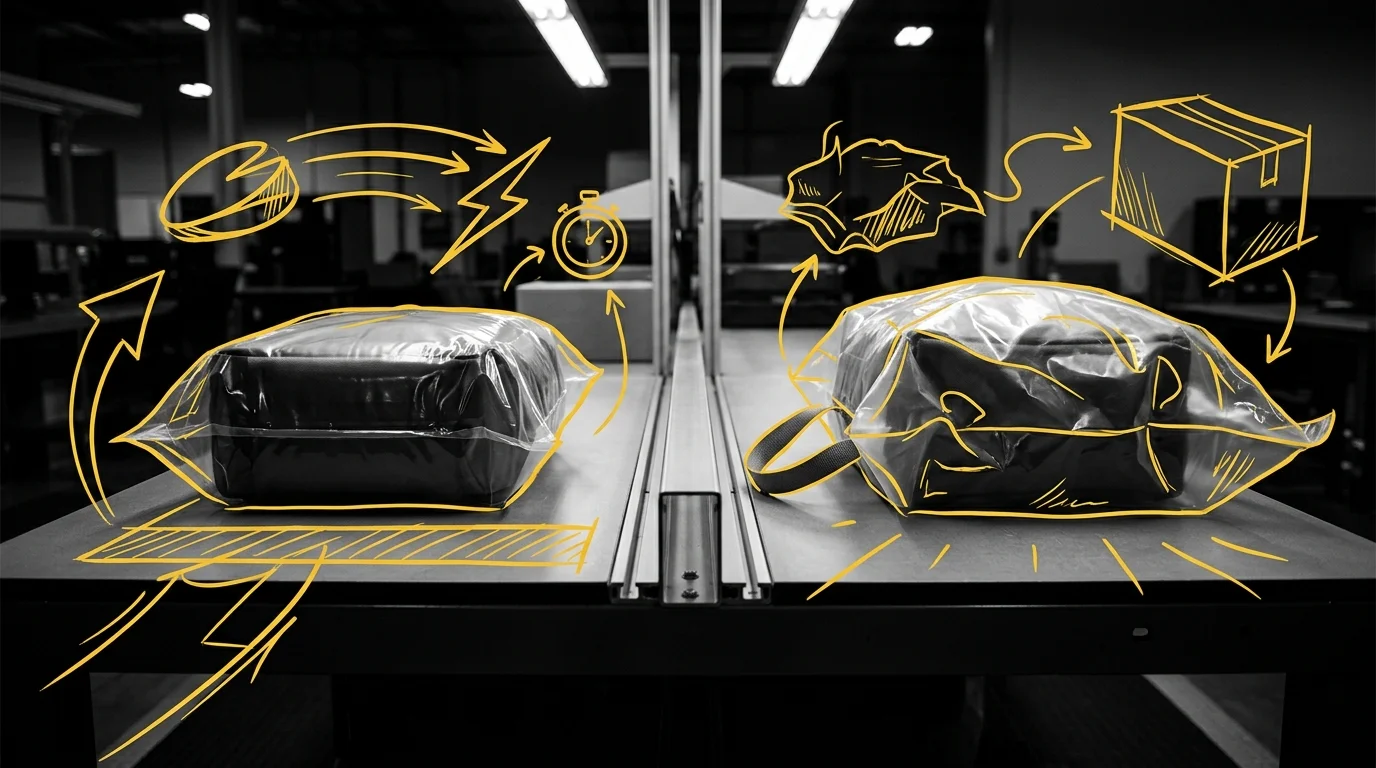
Sensor behavior is fixed. Packaging is not.
That distinction matters, because packaging is the one input in this whole chain an operator actually controls. Everything upstream of it, from sensor settings to size-tier bands, is Amazon’s design, not an operator’s choice.
Fitted Packaging Versus Loose Packaging
Fitted packaging holds a product’s true footprint. Loose packaging invents a bigger one. A bag cut too large, or sealed with slack material bunched at the edges, hands the sensor a shape that doesn’t match what’s inside it. Measure the packed unit, not the bare product, and log that figure before the shipment goes out.
Handles Straps and Protruding Elements
Handles are a specific version of this problem. A strap or handle left protruding past the product’s edge reads as additional length to a sensor that only sees outline, not function.
Same logic applies to anything built to stick out, like a hang tab or a clip. Fold it flat, remove it if the product works without it, or include it in your own measurement so your figure matches what Amazon will record.
Why ‘Set and Forget’ Dimension Management Fails
So why does a healthy-looking fee report lull operators into skipping the check entirely? Because the dashboard only shows what’s already been billed, never what’s been missed. Advertising metrics get watched daily, while dimension accuracy, the input sitting underneath every fulfillment fee on every order, rarely gets watched at all.
The Mechanics of Chronic Overcharge Accumulation
Proactively monitoring product dimensions and fee reports is a non-negotiable part of running an Amazon channel, not an optional add-on to it.
Here’s how the math builds. A fee that’s a little high on one unit is a little high on every unit after it. A SKU that sells thousands of units a quarter turns a small per-unit error into a real line on the P&L, and refunds only reach back so far.
An account can show disciplined ACoS and still lose margin through a measurement nobody challenged. Challenging those measurements is a job for Amazon Account Management, not for the ad console. Advertising work protects one part of the P&L. It does nothing for the fee line underneath it.
The Correction Pathway Step by Step

The fix runs in three steps. Find the error. Ask for the rescan. Claim back what was overcharged. Each step depends on evidence, not assumption.
| Step | When It Applies | Window or Rule |
|---|---|---|
| Remeasurement request | Amazon’s figure on file doesn’t match the packed product | Review typically takes about 10 days, per U.S. Seller Forums replies |
| Fee reimbursement claim | Fees were charged on the wrong weight or dimensions | 90 days from the date each fee was charged, per trade guides; confirm in Seller Central |
| Ships in Own Container (SIOC) | The package’s longest side is between 70 and 96 inches | Amazon says it must be classified as SIOC |
Requesting a Product Remeasurement
So where does the correction actually start? Inside Seller Central, with a remeasurement request for each FNSKU that looks wrong. Trade guides and a reply on Amazon’s U.S. Seller Forums describe the route as the “Remeasure FBA products and confirm fees” tool, or a case filed under FBA Product Dimensions and Weight. Send your measured packed dimensions with it. Amazon rescans the unit, and its own figure decides the result.
Filing the Reimbursement Claim
But a corrected measurement doesn’t return past fees on its own. That takes a separate reimbursement claim. According to a reply on Amazon’s U.S. Seller Forums, “you have 90 days from the fee charge date to submit a request.” Amazon changes these windows, so check the current number in Seller Central before you file. Any overcharge older than the window stays uncollected, so file the same week the error is confirmed.
The 70-to-96-Inch Packaging Rule
Size limits matter at the long end too. Amazon’s Seller Central help page says that if a package’s longest side is between 70 and 96 inches, it “must be classified as Ships in Own Container (SIOC).” If your packed length sits close to 70 inches, measure carefully, because a small error decides which side of that rule the item falls on.
Frequently Asked Questions
Operators studying this system tend to circle back to the same handful of questions. Here’s the direct version of each one.
How often can I ask Amazon to re-measure the same SKU?
Trade sources say each FNSKU can be re-measured at most twice within 60 days, and most accounts can file 20 to 30 requests a month, with the count resetting on the first of the month. Amazon changes these limits, so check the current numbers in Seller Central before you plan a batch.
What is the best way to package my products to avoid dimension errors by Amazon?
Fit the package to the product. Trim extra poly bag material, tuck or remove any handle or strap that sticks out, and measure the packed unit before it ships.
Can I get reimbursed for past FBA fees if I find a measurement error today?
Yes, for charges still inside the window. Trade guides put it at 90 days from the date each fee was charged. File the claim once the corrected measurement is confirmed, and check the current window in Seller Central first.
How long does it typically take for Amazon to process a re-measurement request and apply corrections?
About 10 days, based on replies on Amazon’s U.S. Seller Forums, though some trade guides put a dimension fix at 7 to 14 business days. The new figure applies from then on. Getting past fees back is a separate claim with its own deadline.
Do corrected dimensions carry over to other Amazon marketplaces?
Only within the same region. Trade guides say new dimensions apply across all marketplaces within the region where the request was made. A store in another region keeps its own figure until it’s checked there.
Where This Leaves You
So the first reading on file is no footnote. It runs every fee line on that SKU until someone checks it.
Here’s where we land: correcting a dimension error isn’t a one-off recovery task. It’s channel discipline applied to the fee structure itself. A SKU’s measurement either gets monitored on purpose, or it drifts unchecked and compounds against your margin with every order.
Put the fee report on the monthly checklist, SKU by SKU. That kind of ongoing check is built into our Account Management work. For a structured look at where your own SKUs stand, start with a free Amazon audit.