
Managing Amazon Chargebacks and Fee Shortages: A Complete Guide
Managing Amazon chargebacks and fee shortages means answering every card dispute inside Amazon’s deadline and checking every fee line against what you should have been charged. On an amazon.com order, a chargeback starts when a buyer asks their bank or card company to reverse a payment. Amazon emails the seller and posts a notice in Seller Central. The seller then has seven calendar days from that email to send the order details: the ship date, the shipping method and the tracking number, plus proof of delivery and buyer messages if they exist. The buyer’s bank makes the final call, not Amazon. Amazon covers chargebacks caused by payment fraud, such as a stolen card. The seller covers service chargebacks, such as an item the buyer says never arrived or wasn’t as described. A fee shortage is a different problem. No buyer or bank is involved. It’s money lost when Amazon charges the wrong fee or doesn’t pay back what it owes: a fulfillment fee based on the wrong size, inventory lost in a warehouse, or units that were never counted after an inbound shipment. Each of these has its own claim window. Lost or damaged warehouse inventory must be claimed within 60 days of being reported. Trade guides put the window for wrong weight or size fees at 90 days from the charge, though Amazon changes these windows. Inbound shipment claims run longer but can only be filed once the shipment closes. Managing both problems comes down to three habits: check chargeback notices and settlement lines on a schedule, gather records before a dispute starts, and fix the root cause so the same loss doesn’t return next month.
Last Updated: October 24, 2026
- • Articles in this cluster
- • What Counts as a Chargeback Versus a Fee Shortage on Amazon
- • Why Banks, Not Amazon, Decide the Outcome of a Chargeback
- • Why Reactive Dispute Handling Breaks Down at Scale
- • Where Amazon's Fee Schedule Creates Room for Shortages
- • How Reimbursement Claims Are Actually Evaluated
- • Building a Reconciliation Process That Catches Discrepancies Before They Compound
-
• Frequently Asked Questions
- • What is the difference between an Amazon A-to-z claim and a credit card chargeback?
- • How long do sellers have to respond to an Amazon chargeback notification?
- • What are the most effective ways to prevent chargebacks on Amazon?
- • What are the most common reasons for Amazon FBA fee shortages and discrepancies?
- • What happens if a seller loses a chargeback dispute, and can the decision be appealed?
- • The Discipline That Protects the Margin
Articles in this cluster
- Inbound shortage claim filing deadlines — Amazon Inbound Shortage Claims: Filing Deadlines You Cannot Miss
- Building a timeline for inbound shortage disputes — How to Build a Timeline for Disputing Inbound Receiving Shortages
- Spotting hidden packaging and labeling fees — How to Spot Hidden Packaging and Labeling Fees on Settlement Sheets
- A line-by-line breakdown of Amazon settlement reports — Reading an Amazon Settlement Report: A Line-by-Line Breakdown
- Automated settlement audits compared to manual fee review — Automated Settlement Audits vs. Manual Fee Review: What Finds More
- Stopping recurring dimension and measurement fee overcharges — How to Stop Recurring Dimension and Measurement Fee Overcharges
- Why Amazon re-measures SKUs and how to fix errors — Why Amazon Re-Measures Your SKUs and How to Correct Errors Fast
- Accounting records needed for chargeback reversal — The Accounting Documentation Amazon Requires to Reverse Chargebacks
- Building a chargeback dispute file Amazon will approve — How to Build a Chargeback Dispute File That Amazon Will Approve
- Contingency fee recovery services compared to in-house deduction audits — Contingency Fee Recovery Services vs. In-House Deduction Audits
- Why Amazon fee shortages are not unavoidable — Why Amazon Fee Shortages Are Not Just an Unavoidable Cost of Selling
What Counts as a Chargeback Versus a Fee Shortage on Amazon
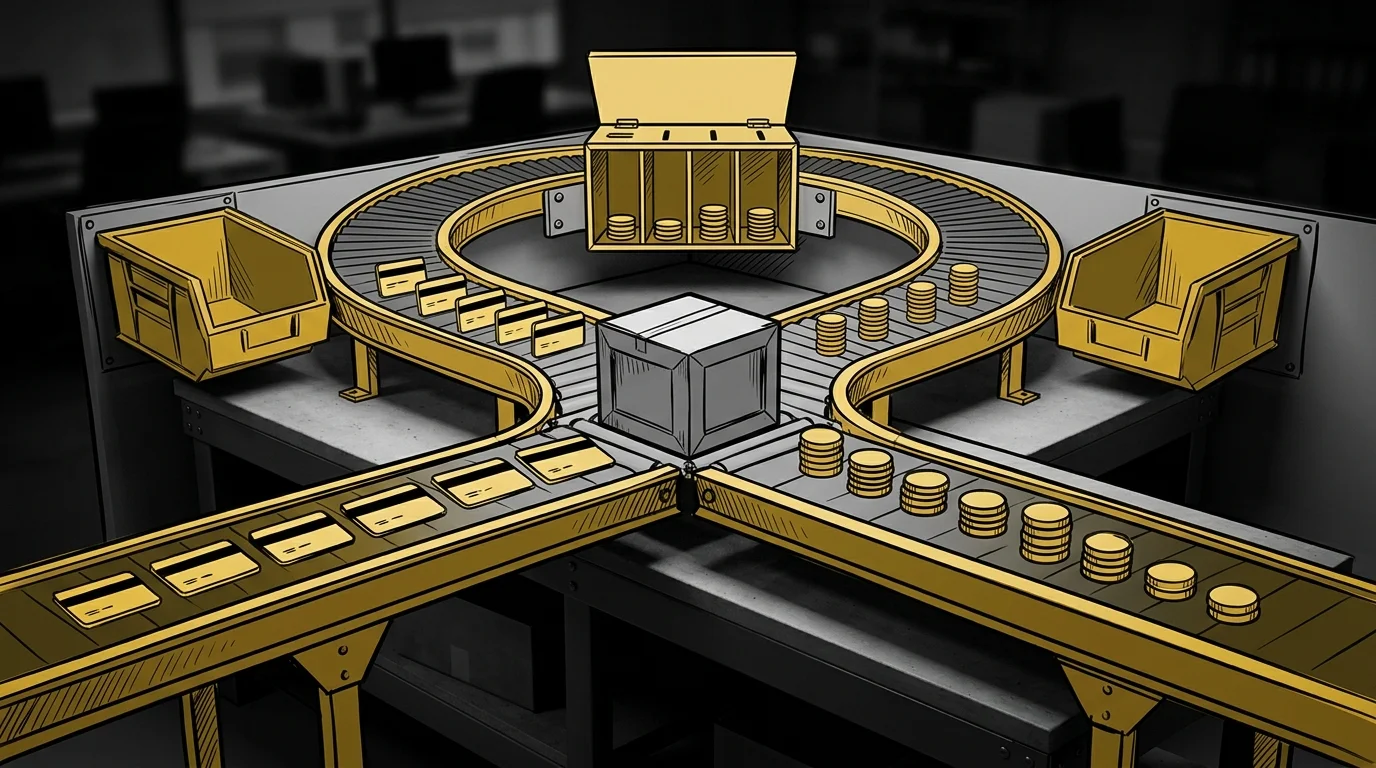
Here’s where sellers often go wrong first: two very different money problems get treated as one. That mix-up is the first operational failure to fix.
One starts with a customer and a bank. The other starts with a math error inside Amazon’s own fee schedule. Treat them as the same problem and both get handled badly.
The Chargeback Mechanism, Defined
On an amazon.com order, a chargeback starts when the buyer goes to their bank or card company instead of the seller or Amazon. According to Amazon’s Sell on Amazon site, the seller then gets “an email or a notification in Seller Central with information about a disputed transaction.” The usual causes are an item the buyer says never arrived, an item that wasn’t as described, or a card used by someone other than its owner.
Put simply, a chargeback is a payment reversal that starts at the buyer’s bank. An A-to-z claim is a different thing. The same Amazon page explains that an A-to-z claim lets the buyer ask Amazon itself to investigate the order, so Amazon makes that call.
The Fee Shortage Mechanism, Defined
A fee shortage never involves a customer or a bank. It’s a math error buried in referral fees, fulfillment fees or storage charges, the kind of line item that routine Account Management reviews are meant to catch.
No dispute gets filed because nobody raised a complaint. The error just sits there until someone goes looking for it. The word “shortage” also covers a second problem in this cluster: units you shipped to Amazon that the warehouse never counted. Those run on their own claim rules, laid out in the inbound shortage claim filing deadlines.
Why Banks, Not Amazon, Decide the Outcome of a Chargeback
A seller can hand over every document Amazon asks for and still lose a chargeback. That isn’t bad luck, and it isn’t arbitrary. The call was never Amazon’s to make.
Amazon’s Sell on Amazon site puts it plainly: “The customer’s bank makes the final decision in favor of either the customer or the seller.” Amazon’s part is to ask the seller for the order details. The bank weighs them. So write the response for a bank reviewer: dates, tracking and proof, not a story.
Where Amazon’s Role Ends and the Bank’s Begins
Amazon does carry some chargebacks itself. Its seller guide says, “We’re responsible for handling payment-related fraud chargebacks, like stolen credit cards or other payment fraud attempts.” Service chargebacks are the seller’s to answer. The guide says sellers “are responsible if the chargeback is due to a service-related reason,” such as an item that didn’t arrive or didn’t match the listing. Fraud chargebacks also “don’t count against your ODR,” your Order Defect Rate.
One common belief needs correcting. Buying labels through Amazon Buy Shipping doesn’t shield a seller from chargebacks. An Amazon staff reply on Amazon’s U.S. Seller Forums says, “All selling partners are subject to chargeback claims despite using Buy shipping services.” What Buy Shipping does cover is A-to-z delivery claims. Amazon’s Buy Shipping page ties that protection to buying the label there, shipping on time and answering buyer messages within 48 hours.
Why Reactive Dispute Handling Breaks Down at Scale
A single chargeback or fee shortage looks like a rounding error. A hundred of them, arriving every week across thousands of SKUs, look like a system with no owner. No clever tactic or one-time cleanup fixes that. Amazon is a channel to be managed with discipline, and disputes are part of the channel’s economics, not a side chore.
The Deadline Problem in a Manual Queue
Every one of these disputes runs on its own clock. Chargebacks give you seven calendar days from Amazon’s email. Lost-inventory claims, customer-return claims and inbound shipment claims each run on their own, longer windows. A manual spreadsheet can’t keep clocks that different straight across hundreds of open cases. And the cases themselves are often signs of something upstream, in fulfillment, listing accuracy or customer service.
How Isolated Disputes Mask a Systemic Pattern
Handling each dispute as its own isolated event hides the pattern connecting them. A cluster of chargebacks tied to one SKU often points to a listing or packaging defect, not customer behavior. Proactively monitoring for and disputing these discrepancies functions as a critical defensive strategy for protecting margin on the channel.
Where Amazon’s Fee Schedule Creates Room for Shortages

Chargebacks get noticed because a bank starts them. Fee shortages don’t announce themselves at all, with no customer, no dispute call, and no alert to flag them.
Amazon’s fee schedule spans referral fees, FBA fulfillment fees, storage fees and inbound fees. Each one is figured from data that can be wrong: a category, a size tier, a weight. A small error in that data repeats on every unit until someone catches it.
| Fee Category | What It Covers | Common Shortage Trigger |
|---|---|---|
| FBA Fulfillment Fees | Picking, packing, and shipping costs tied to a product’s size tier and weight | A dimension or weight change at the warehouse reclassifies the item into a higher tier without the seller noticing |
| Referral Fees | A percentage charge on each sale, varying by product category | A miscategorized listing pulls a higher referral rate than the category the product actually belongs to |
| Storage Fees | Monthly charges for inventory held in Amazon’s fulfillment network | A wrong unit size on file raises the monthly charge on every unit stored |
| Returns Processing Fees | Charges and reimbursements tied to customer returns moving back through the fulfillment network | A refunded item that never comes back, or comes back and isn’t reimbursed; these claims can be filed 60 to 120 days after the refund date |
How Reimbursement Claims Are Actually Evaluated
Amazon reviews a reimbursement claim against its records for one transaction or one unit, not against how much the loss hurts. The rules are narrow, and a claim that misses one of them can fail before anyone checks the math underneath.
| Claim Element | Requirement | Why It Matters |
|---|---|---|
| Order and charge identification | Reference the exact order ID and the specific fee charge, not a general complaint. | A specific transaction gives the reviewer something to check. |
| Correct fee calculation shown | The submission must show what the fee should have been, using Amazon’s own published fee structure for that category and size tier. | A claim that only states the fee looks wrong, without showing the correct figure, gives the reviewer nothing to approve against. |
| Timing within the claim window | File inside the window for that claim type: 60 days from the loss report for warehouse inventory, 60 to 120 days after the refund for customer returns. | A well-documented claim filed too late fails for the same reason as an undocumented one filed on time: the window closed. |
Lost and Damaged Inventory Since the 2024 Changes
Amazon changed how lost inventory gets paid back. In its announcement on Amazon’s U.S. Seller Forums, Amazon said claims for items lost or damaged in its warehouses “must be submitted no later than 60 days after the item was reported lost or damaged,” starting October 23, 2024. The same post said, “Starting November 1, 2024, we’ll proactively reimburse you” for items lost in its fulfillment centers, so a manual claim is only needed when that payment doesn’t arrive. A later Amazon forum update set the value: “Effective March 10, 2025, we’ll reimburse you based on the product manufacturing cost of the affected inventory.” That covers losses before a sale. Losses after a sale are still paid at the sale price minus fees.
What Documentation a Claim Requires
Here’s the reality: a claim has to be complete when it goes in. Gather the order ID or FNSKU, the fee charged, the fee it should have been, and the record that proves it before filing. For lost inventory paid at manufacturing cost, enter your real cost in the Inventory Defect and Reimbursement portal under “Manage Your Manufacturing Cost.” If you don’t, Amazon uses its own estimate.
Building a Reconciliation Process That Catches Discrepancies Before They Compound

Catching a shortage before it compounds requires a process, not a periodic glance at the dashboard. A reconciliation system treats every transaction and fee line as a data point to be checked, not a number to be trusted. That shift is what separates a managed channel from one left to drift.
| Review Step | Frequency | What It Catches |
|---|---|---|
| Transaction-level fee audit | Ongoing, against every settled order | Referral fee miscalculations, incorrect fulfillment fee tier assignments, and storage charge errors tied to a single SKU |
| Chargeback queue review | Daily, so no notice gets near its deadline | Chargeback notices getting close to the response deadline before tracking and delivery proof are pulled |
| Pattern analysis across SKUs | Periodic, layered on top of transaction-level checks | Clusters of chargebacks or shortages pointing to a listing defect, packaging issue, or recurring fee-code error rather than isolated incidents |
| Root-cause tracing on closed discrepancies | After each resolved case | Whether the same shortage type is likely to recur, so a fix addresses the source instead of only the symptom |
Setting a Review Cadence Against the Filing Window
A review cadence is only as good as its respect for the filing window each claim carries. Check fee data on a schedule tighter than the submission deadline, and a shortage never ages out of eligibility. Amazon’s dispute mechanics don’t wait for a seller to notice.
Tracing a Shortage Back to Its Root Cause
Flagging a discrepancy isn’t the same as closing it. A shortage traced to its source, whether a mislabeled SKU or a storage tier miscalculation, gets fixed at the root instead of disputed again next month. That tracing is what keeps the same loss from coming back.
Frequently Asked Questions
A few procedural questions come up constantly once the chargeback and fee shortage mechanics are clear. Here are the direct answers.
What is the difference between an Amazon A-to-z claim and a credit card chargeback?
An A-to-z claim asks Amazon to look into the order, and Amazon decides it. A chargeback goes to the buyer’s bank, and the bank decides. Buy Shipping can protect you from the first kind on delivery complaints, but not from the second.
How long do sellers have to respond to an Amazon chargeback notification?
Seven calendar days from the date of Amazon’s email. Amazon’s Sell on Amazon site tells sellers to “respond within seven calendar days of the email date.” Have the ship date, shipping method and tracking ready, plus proof of delivery if you have it.
What are the most effective ways to prevent chargebacks on Amazon?
Prevention starts upstream with accurate listings, responsive customer service, and reliable fulfillment. Those cut off the conditions that lead to disputed charges. Watching for chargeback patterns on a single SKU catches a packaging or listing defect early.
What are the most common reasons for Amazon FBA fee shortages and discrepancies?
Shortages typically trace back to referral fee miscalculations, fulfillment fee errors, or storage charge discrepancies. These sit inside the fee schedule’s complexity and rarely surface without active reconciliation.
What happens if a seller loses a chargeback dispute, and can the decision be appealed?
Usually the decision stands. An Amazon staff reply on the U.S. Seller Forums says it “is ultimately the issuing bank’s decision and this is often final.” So put everything into the first response, inside the deadline.
The Discipline That Protects the Margin
A leaking container doesn’t fail all at once. It fails one unwatched seam at a time, and a chargeback or a fee shortage is exactly that kind of seam.
Call either one a cost of doing business and the leak keeps running. Operational discipline is the patch. That gap is the whole difference between a channel that’s managed and one that’s merely open.
Start with three checks this week: any chargeback email still open, any lost-inventory report Amazon hasn’t paid, and any fee line that doesn’t match the size tier you expect. A protected channel is checked on a cadence and traced to root cause rather than argued case by case. If the margin slipping out of your Amazon channel is the problem worth fixing, start with a free Amazon audit.